Sea to Sky Gondola vs Grouse Mountain
Squamish: Sea to Sky Gondola Admission Ticket
- Free cancellation
Should I visit the Sea to Sky Gondola or Grouse Mountain?
Grouse Mountain is closer to downtown Vancouver, easier to reach without a car, and has a grizzly bear refuge and organized shows. The Sea to Sky Gondola is further away near Squamish but is quieter, generally considered more scenic for photography of Howe Sound, and includes a suspension bridge. Neither is a universal winner — it depends on time available and what you're prioritizing.
Both the Sea to Sky Gondola and Grouse Mountain answer the same basic traveler question — “where can I get big mountain views near Vancouver without driving to Whistler” — but they answer it in genuinely different ways. One is closer and busier, the other is farther and quieter, and the honest answer to “which one” depends more on how much time a visitor has and what they’re actually after than on either one being objectively better.
| Distance | Grouse 20-30min; Sea to Sky Gondola 45-60min |
| Cost | Broadly similar for standard admission |
| Time needed | Gondola 1.5-3hrs; Grouse 3-5hrs |
| Best for wildlife/families | Grouse (grizzly refuge) |
| Best for photography/quiet | Sea to Sky Gondola |
| Booking | Advance ticket avoids base-station lines at either |
The basics
Grouse Mountain sits directly behind North Vancouver, reachable in 20-30 minutes from downtown by car, or by SeaBus plus a connecting bus for visitors without one. It’s been operating as a visitor attraction for decades and has built out accordingly: an aerial tram (the Skyride), a resident grizzly bear refuge, a summer lumberjack show, and winter skiing, all bundled under one Grouse Mountain admission ticket.
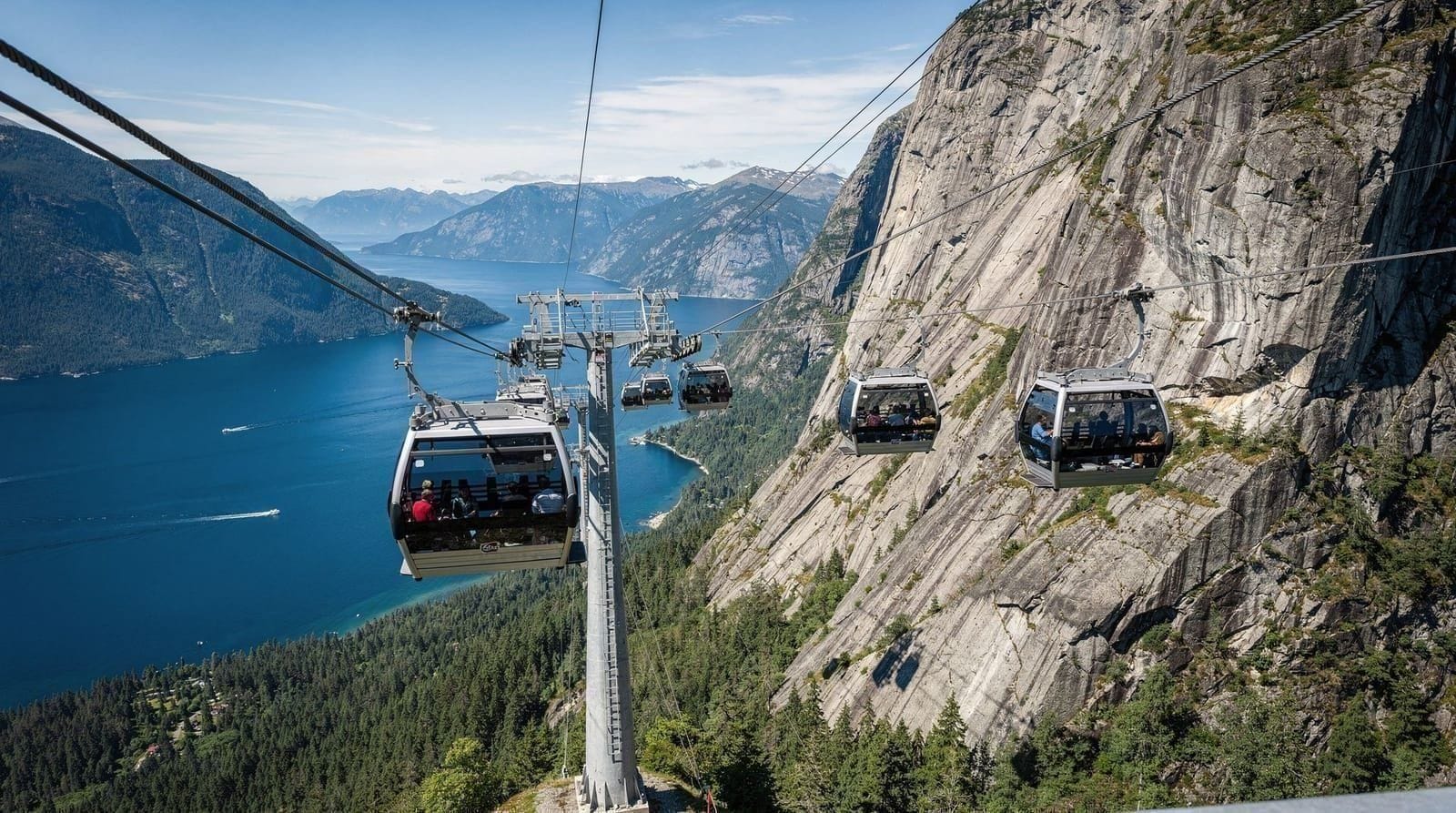
The Sea to Sky Gondola sits near Squamish, roughly 45-60 minutes north of downtown Vancouver along the Sea-to-Sky Highway. It opened in 2023, considerably more recently than Grouse’s long-established Skyride, and its main draws are an 885-metre ascent to a summit area with sweeping views over Howe Sound and the Stawamus Chief, plus a suspension bridge near the top. A Sea to Sky Gondola admission ticket covers the round-trip ride and access to the summit trails and bridge.
Comparison table
| Sea to Sky Gondola | Grouse Mountain | |
|---|---|---|
| Distance from downtown | 45-60 min drive | 20-30 min drive, or SeaBus + bus |
| Opened | 2023 | Decades-established |
| Ascent | 885 m | Base ~290m to summit 1,100m |
| Wildlife | None | Resident grizzly bear refuge |
| Standout feature | Howe Sound and Stawamus Chief views, suspension bridge | Grizzly bears, lumberjack show, winter skiing |
| Crowd level | Quieter, more remote feel | Busier, closer to downtown tourist traffic |
| Best for | Photography, quieter mountain time | Wildlife, families, visitors without a car, winter skiing |
Distance and access
This is the most concrete difference between the two. Grouse is genuinely close to Vancouver — close enough that it’s a realistic half-day outing even for visitors without a rental car, thanks to the SeaBus-plus-bus connection from downtown. The Sea to Sky Gondola requires either a car or a tour, since there’s no direct transit route from Vancouver to Squamish that’s practical for a casual day visit; most visitors without their own vehicle book a guided tour that includes transport, or combine it with a Whistler day trip along the same highway.
Crowds and atmosphere
Grouse Mountain’s proximity to downtown and its long operating history mean it draws a heavier, more constant stream of visitors — tourists, cruise passengers, and locals alike, especially on summer weekends when Skyride lines at the base can run 30-45 minutes. The Sea to Sky Gondola, being both farther from the city and newer, tends to feel less crowded and more remote, even though it’s grown in popularity since opening. Visitors who find Grouse’s tourist-attraction atmosphere (shows, gift shops, a busy summit chalet) a bit much often prefer the Sea to Sky Gondola’s comparatively quieter, more scenery-focused setup.
Photography and views
For photographers specifically, the Sea to Sky Gondola has a strong case as the more dramatic subject: its summit area looks directly down over Howe Sound and across to the Stawamus Chief, a massive granite monolith that’s one of the most recognizable formations in the region, plus a suspension bridge that adds a clear foreground element to wide shots. Grouse’s views are also legitimate — a clear day gives sightlines across the whole Vancouver metro area and out to Vancouver Island — but the view is more of a broad cityscape panorama than the Sea to Sky Gondola’s more compact, dramatic mountain-and-fjord composition.
Wildlife and family activities
Grouse wins decisively here, and it isn’t close. The grizzly bear refuge, home to two bears living in a naturalistic forested enclosure, is a genuine wildlife encounter that the Sea to Sky Gondola simply doesn’t have an equivalent to. Combined with the summer lumberjack show and a general density of organized activities at the summit, Grouse is the stronger choice for families with kids or anyone wanting more than a viewpoint and a walk.
Winter skiing
Grouse operates as a modest ski hill from roughly December through March, with night skiing under lights as a genuine novelty few resorts offer. The Sea to Sky Gondola does not offer downhill skiing, though it does run winter programming including snowshoeing trails at the summit. Visitors specifically wanting to ski minutes from downtown Vancouver have only one of these two options, and it’s Grouse.
Cost
Pricing between the two runs in a broadly similar range for standard admission, though Grouse’s “Ultimate” pass bundles in more (wildlife refuge, show access) than the Sea to Sky Gondola’s ticket, which is more narrowly focused on the ascent, viewpoints, and suspension bridge. Neither is meaningfully cheaper than the other once comparable tiers are matched — the bigger cost variable for most visitors is transport, since reaching the Sea to Sky Gondola without a car typically means paying for a tour or shuttle on top of admission.
Combining both
For visitors with more than a single day to spend on mountain viewpoints, doing both isn’t unreasonable — they’re different enough experiences that neither feels redundant after the other, and both sit along routes that connect logically with a broader North Shore or Sea-to-Sky itinerary. Visitors extending their trip toward Whistler will likely pass close to the Sea to Sky Gondola regardless, making it an easy add-on to a Whistler day rather than a separate dedicated trip.
The honest verdict
There isn’t a single correct answer here, and any comparison claiming otherwise is oversimplifying. Visitors with limited time, no car, or traveling with kids are generally better served by Grouse — it’s closer, reachable without a rental car, and has the wildlife refuge that families in particular respond to. Visitors prioritizing photography, a quieter mountain experience, or already planning a drive up the Sea-to-Sky corridor toward Whistler are generally better served by the Sea to Sky Gondola.
Neither choice is a mistake; they’re simply optimized for different trips. Visitors weighing the North Shore’s other mountain options alongside Grouse should also see how Grouse compares to Cypress Mountain and Mount Seymour, since that’s a genuinely different comparison than Grouse versus the Sea-to-Sky corridor.
Anyone hiking rather than riding up should also note that Grouse has a free (if punishing) hiking alternative in the Grouse Grind, while the Sea to Sky Gondola’s summit trails are accessible only via the gondola itself — there’s no equivalent free hike-up option at Squamish.
Trail networks at the top
Both sites offer trails once you’re at the summit, but they differ in scope. Grouse’s summit trail network is relatively compact, centered around the wildlife refuge, the chalet area, and short walking loops, since the mountain’s design emphasizes attractions over extensive hiking.
The Sea to Sky Gondola has a more developed network of marked trails radiating from its summit area, including routes leading toward Al’s Habrich Ridge Trail, a moderate hike with additional viewpoints beyond the main gondola summit platform — genuinely worth the extra time for visitors who want more than the immediate viewing deck. Hikers looking to turn either stop into a half-day rather than a quick viewpoint visit will generally find more trail variety at the Sea to Sky Gondola.
The suspension bridge factor
The Sea to Sky Gondola’s summit suspension bridge is a specific, single feature that doesn’t have a direct equivalent at Grouse. It’s a shorter, less elaborate structure than the well-known Capilano Suspension Bridge closer to the city, but it adds a distinct activity and photo opportunity to the Sea to Sky Gondola visit that Grouse’s summit doesn’t include. Visitors who’ve already done Capilano and are looking for something different, rather than a second suspension bridge experience, should weigh this — the Sea to Sky Gondola’s bridge is a nice bonus but not a headline attraction on the scale of Capilano’s, so it shouldn’t be the deciding factor on its own.
Food and amenities
Grouse’s summit has a considerably more developed food and amenities setup, reflecting its longer operating history and higher visitor volume — a full chalet with multiple dining options, gift shops, and indoor space to wait out poor weather. The Sea to Sky Gondola’s summit amenities are more modest, with a smaller cafe and viewing area, reflecting both its newer age and generally lower visitor throughput. Visitors planning to spend a full afternoon at either site and wanting a proper sit-down meal at the top will find more options at Grouse; those happy with a coffee and a snack won’t notice much difference.
Accessibility for visitors with mobility considerations
Grouse’s Skyride cabin and summit chalet area are relatively accessible, with paved paths connecting the main attractions near the summit station, making it a more realistic option for visitors with mobility limitations who still want a genuine mountain-top experience. The Sea to Sky Gondola’s summit area includes some accessible viewing points near the top station, but many of its more scenic trail sections and the suspension bridge involve uneven terrain, stairs, or grades that are less manageable for visitors using mobility aids. Travelers with specific accessibility needs should check current accessibility information for both sites directly before visiting, since infrastructure and trail conditions can change.
What’s nearby each site
Part of deciding between the two also comes down to what else is worth seeing nearby. The Sea to Sky Gondola sits close to downtown Squamish, a small town with its own set of attractions — Shannon Falls, one of BC’s tallest waterfalls, sits practically next door, and the Stawamus Chief itself draws serious rock climbers year-round, giving the area a genuine outdoor-recreation identity beyond just the gondola. Visitors combining a Sea to Sky Gondola visit with a broader Squamish stop can reasonably turn it into a half-day or more without repeating themselves.
Grouse Mountain’s neighborhood, meanwhile, sits within North Vancouver, close to Capilano Suspension Bridge (about 10 minutes away by car) and a short drive from other North Shore stops like Lynn Canyon and Deep Cove. Visitors basing a day around Grouse have an easier time stacking multiple North Shore attractions into a single outing than visitors basing a day around the Sea to Sky Gondola, simply because North Vancouver’s attractions sit closer together than Squamish’s more spread-out points of interest.
Booking and advance planning
Both sites benefit from advance ticket purchase, particularly in peak summer months when base-station lines can build at either location. A Sea to Sky Gondola admission ticket booked ahead avoids on-site ticket counter waits, and the same applies to Grouse’s Skyride — booking in advance is less about guaranteeing entry (neither typically sells out completely) and more about skipping a queue that can otherwise eat 20-30 minutes of a visit on a busy day.
Time budget for each
A focused Sea to Sky Gondola visit — ride up, walk the suspension bridge, see the main viewpoint, ride down — can be done in as little as 1.5 to 2 hours, though most visitors who add the Habrich Ridge Trail or a coffee stop end up spending closer to 3 hours. A Grouse Mountain visit typically runs longer given the added draws — allowing time for the wildlife refuge and a show pushes a typical visit to 3-5 hours. Visitors with tightly scheduled days should factor this difference in: the Sea to Sky Gondola is the faster stop of the two, even accounting for its longer drive from downtown Vancouver.
Weather and cancellation risk
Both sites can be affected by high wind, which occasionally suspends gondola or tram service at either location — this is a shared risk rather than a point of difference, since both systems are engineered similarly and both operate in the same regional weather patterns.
What does differ slightly is exposure: the Sea to Sky Gondola’s more open valley setting near Howe Sound can see stronger, more sustained coastal wind on certain weather patterns than Grouse’s more sheltered North Shore location, though this varies enough day to day that it shouldn’t be treated as a firm rule for planning purposes. Checking each operator’s current status page on the morning of a planned visit is the more reliable approach than assuming one site is categorically less weather-affected than the other.
Ticket flexibility and cancellation policies
Both the Sea to Sky Gondola and Grouse Mountain generally offer free cancellation windows on advance bookings, which is worth taking advantage of given the weather variability described above — booking a ticket for a specific date without a flexible cancellation policy adds real risk if the forecast turns out poorly. Visitors planning either visit around a specific narrow weather window, such as trying to catch a single clear day during an otherwise cloudy trip, should specifically confirm cancellation flexibility before booking rather than assuming it by default.
A word on repeat visits
For visitors who’ve done Grouse on a previous Vancouver trip and are returning to the city, the Sea to Sky Gondola is a natural next stop precisely because it offers a different enough experience to feel worth the extra drive time — different scenery, different pace, and a genuinely different atmosphere. Conversely, first-time visitors with only one North Shore-area mountain stop in their itinerary and no strong preference either way are generally better served defaulting to Grouse, given its stronger combination of proximity, transit access, and breadth of on-site activities for a first Vancouver mountain experience.
Seasonal differences between the two
Grouse offers a genuine winter identity that the Sea to Sky Gondola doesn’t match — night skiing under lights, a full ski hill operation, and winter-specific programming that draws a different crowd than its summer visitors. The Sea to Sky Gondola runs through winter as well, with snowshoeing trails at the summit as its main cold-weather draw, but it doesn’t offer downhill skiing and has a comparatively quieter winter program overall.
For visitors specifically planning a winter trip and wanting a snow-sports option close to the city, Grouse is the more complete choice; for winter visitors mainly wanting snow-covered mountain views and a quieter walk, the Sea to Sky Gondola’s winter operation still delivers a worthwhile visit, just a narrower one than its summer program.
Group size and tour dynamics
Visitors traveling in larger groups, including families with a wide age range or groups with mixed fitness levels, may find Grouse easier to manage as a group activity, given the variety of things to do at different energy levels — some visitors can hike the Grind while others take the tram, then everyone reconvenes at the summit for the bears and the show. The Sea to Sky Gondola’s more focused offering (the ride, the bridge, a couple of trails) is simpler to plan around but offers fewer built-in options for splitting a group by interest or ability, which is worth considering for anyone organizing a visit with people who have meaningfully different fitness levels or interests.
Which one first-time cruise passengers should pick
Cruise passengers with a single shore day in Vancouver face a specific version of this decision, since time is unusually tight. Grouse is the more realistic choice for a cruise shore excursion given its shorter transit time and closer proximity to the cruise terminal at Canada Place, leaving more of a compressed day for other downtown sightseeing. The Sea to Sky Gondola’s longer drive makes it a harder fit for a typical 8-to-10-hour port call unless it’s the singular focus of the day, with little else planned around it.
Repeat visitors deciding what to add on a second trip
Travelers returning to Vancouver after already covering the basics on a first trip are often the best-suited audience for the Sea to Sky Gondola specifically, since it pairs naturally with a second trip that also pushes further up the corridor toward Squamish or Whistler — activities a rushed first-time visitor typically doesn’t get to. First-time visitors with only one North Shore-style stop in their itinerary and no particular photography or quiet-pace priority are still generally best served defaulting to Grouse for its shorter travel time and broader range of on-site activities.
The takeaway for trip planners
Neither the Sea to Sky Gondola nor Grouse Mountain is a mistake to add to a Vancouver-area itinerary, and for visitors with enough time, doing both remains a reasonable option rather than an either-or decision. But for anyone forced to choose just one given a tight schedule, the honest answer comes down to priorities: proximity and breadth of activities favor Grouse, while scenery, quiet, and a more contemplative pace favor the Sea to Sky Gondola. Matching that tradeoff to the specific traveler’s priorities, rather than defaulting to whichever has more name recognition, is the more useful way to decide.
Top experiences
Bookable activities with verified prices and instant confirmation on GetYourGuide.