Getting from YVR to downtown Vancouver
Vancouver: Airport Transfer to Downtown Vancouver
What's the best way to get from YVR to downtown Vancouver?
The Canada Line SkyTrain is the fastest and cheapest option for most travelers — about 25 minutes to Waterfront Station for roughly CAD 10.85 total (one-zone fare plus the YVR AddFare). Taxis and rideshare take 30-40 minutes depending on traffic and cost CAD 35-55, which makes more sense for groups, heavy luggage, or late-night arrivals when trains run less frequently.
Vancouver International Airport (YVR) sits on Sea Island, about 15 kilometres south of downtown, and getting from the terminal to a hotel bed is one of the more straightforward airport transfers in North America — mostly because the Canada Line SkyTrain runs directly from the terminal into the heart of downtown with no transfers required.
| Where | YVR (Sea Island) to downtown Vancouver, ~15km |
| Fastest/cheapest | Canada Line SkyTrain, around 25 minutes, around CAD 10 |
| Best for groups/luggage | Taxi, rideshare or pre-booked transfer, around CAD 35-90 |
| Getting there | SkyTrain platform is an 8-10 minute walk from arrivals |
| Late-night arrivals | After around 12:30am, plan on taxi or pre-booked transfer |
The Canada Line SkyTrain — the default choice
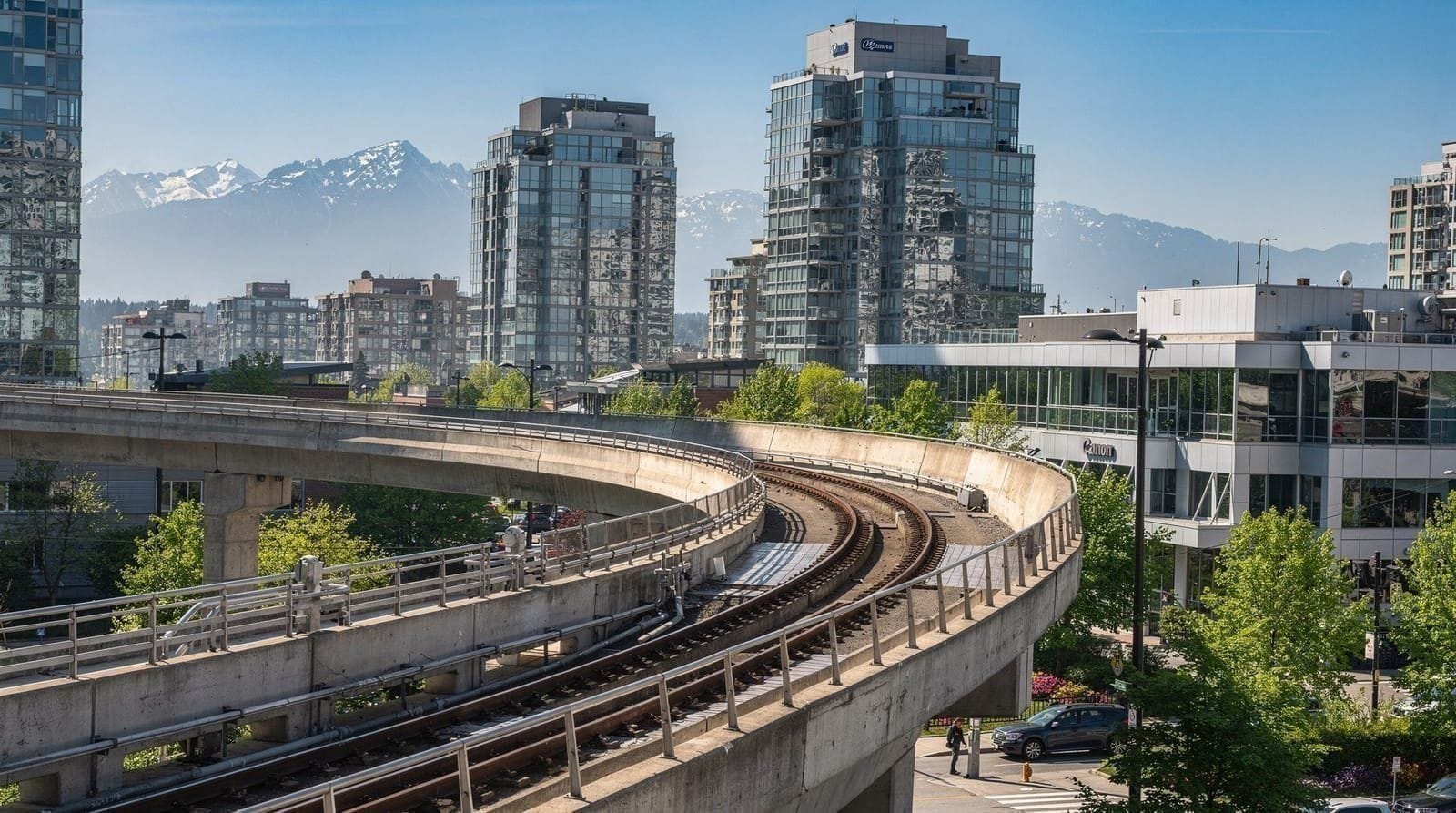
The Canada Line is an automated, driverless rapid transit line that connects both YVR terminals (Domestic and International share a station area, with a short walk or moving walkway between them) directly to Waterfront Station downtown, with stops along the way at Bridgeport, Marine Drive, Oakridge-41st, Broadway-City Hall, and several others useful for travelers staying outside the core. The ride from the airport to Waterfront takes roughly 25 minutes, and trains run every 6-8 minutes during the day, dropping to every 15-20 minutes late at night.
Fare-wise, the Canada Line uses the same TransLink zone system as the rest of the network, with one addition: a YVR AddFare of CAD 6.50 is charged on top of the normal Compass fare when boarding at either airport station, but only in that direction. Riding from downtown out to the airport doesn’t incur the AddFare. So a one-way trip from YVR to a downtown hotel runs about CAD 9.35 (one-zone fare of CAD 2.85 plus the AddFare) during regular hours, or slightly more if the fare zone crossed pushes it into the two-zone band. Most downtown hotels fall within one zone of Waterfront Station, so CAD 9.35-10.85 covers the typical trip.
Tickets and Compass Cards are available from vending machines directly inside both airport stations — they accept credit, debit, and cash, and issue either single-use tickets or a reloadable Compass Card with a refundable CAD 6 deposit. Anyone planning more than a couple of transit trips during their stay should load a Compass Card rather than buying single tickets each time; the TransLink SkyTrain guide covers the full fare structure and how the 90-minute transfer window works across SkyTrain, SeaBus, and buses.
Why the SkyTrain usually wins
For a solo traveler or a pair without oversized luggage, the Canada Line is close to unbeatable on both time and cost. It bypasses road traffic entirely, which matters most during weekday rush hours (roughly 3:30-6:30pm) when the parallel route on Highway 99 and Oak Street backs up noticeably. A taxi that might take 30 minutes at 10am can stretch to 45-50 minutes at 5pm, while the SkyTrain holds steady at 25 minutes regardless of road conditions.
The one real downside is the walk. Waterfront Station connects to the downtown core, but if a hotel isn’t within easy walking distance of a station, travelers need to factor in either a transfer to a bus, a short taxi ride from the station, or a longer walk with luggage. Stations along the line have elevators, so it’s manageable with wheeled luggage, but three large suitcases plus a stroller is a different proposition than a single backpack.
Taxi and rideshare
Metered taxis and rideshare services (Uber and Lyft both operate at YVR, picking up from a designated area outside arrivals) take 30-40 minutes to downtown under normal traffic and cost roughly CAD 35-55, depending on exact destination, time of day, and surge pricing for rideshare. This is the more practical option for groups of three or four splitting the fare, anyone with mobility constraints, families with young children and full luggage, and late-night or early-morning arrivals outside SkyTrain operating hours.
Worth noting: YVR has designated taxi stands with a fixed queue system just outside the arrivals doors, and drivers there are licensed and metered — there’s no need to negotiate a fare or use anyone approaching inside the terminal offering a ride, which is a minor but real scam risk covered in more detail in Vancouver scams to avoid.
Pre-booked private transfers
For travelers who’d rather not deal with luggage logistics on public transit after a long-haul flight, or who are arriving as a group of four or more, a pre-booked private airport transfer to downtown puts a driver at arrivals holding a name sign, with a fixed price agreed in advance rather than a metered fare that can climb in traffic.
Split three or four ways, the per-person cost often lands close to what separate taxis would cost, with the added benefit of one vehicle handling all the luggage. For late or overnight arrivals when SkyTrain frequency drops and taxi queues can be unpredictable, a pre-arranged private transfer removes that uncertainty entirely, since the booking is confirmed regardless of what time the flight actually lands.
Cost and time side by side
| Option | Time to downtown | Cost (1 person) | Cost (family of 4) |
|---|---|---|---|
| Canada Line SkyTrain | ~25 minutes | CAD 9.35-10.85 | CAD 30-40 (kids under 5 ride free) |
| Taxi | 30-40 minutes | CAD 35-45 | CAD 45-55 (larger vehicle) |
| Rideshare (Uber/Lyft) | 30-40 minutes | CAD 30-50 (surge-dependent) | CAD 45-65 (XL vehicle) |
| Pre-booked private transfer | 30-40 minutes | CAD 60-90 flat | CAD 90-130 flat |
| Rental car pickup | Varies | CAD 50-100/day economy | CAD 120-200/day SUV |
These are rough ranges rather than fixed prices — taxi and rideshare fares shift with traffic and demand, and private transfer pricing depends on vehicle size and distance to the specific hotel. The SkyTrain fare is the only one that stays constant regardless of time of day or traffic, which is part of why it’s the default recommendation for most travelers.
Accessibility and mobility considerations
Both YVR Canada Line stations have elevators alongside the escalators and stairs, and the platforms are level-boarding, so wheelchair users and travelers with strollers or heavy luggage carts can use the SkyTrain without needing assistance at the station itself. That said, the walk from the arrivals hall to the station platform is longer than it looks on paper — figure 8-10 minutes of walking and one elevator transition, more if connecting flights land at the far end of the International Terminal. Travelers who’d rather avoid that walk entirely, or who are managing a mobility device that makes transfers difficult, are usually better off with a taxi or pre-booked transfer, both of which pick up curbside a short walk from the arrivals doors.
Hotel shuttles and courtesy vans
A handful of larger hotels and some airport-area properties in Richmond run their own courtesy shuttles, but very few full-service downtown hotels offer airport pickup given the 25-minute SkyTrain connection makes it largely unnecessary. Worth checking directly with a hotel before assuming a shuttle exists — most downtown properties will simply point guests to the Canada Line.
Seasonal and event-driven considerations
YVR gets noticeably busier during peak summer months (July-August) and around the winter holidays, when arrival halls and immigration queues run longer than average — building in an extra 30-45 minutes of buffer before a same-day onward connection is sensible during those windows.
Ski season (roughly late November through April) also brings a steady stream of travelers connecting directly from YVR to rental cars or private transfers heading up the Sea-to-Sky Highway toward Whistler, bypassing downtown entirely — if that’s the plan, picking up a rental car straight from the airport counter saves backtracking through the city later. Cruise season (May through September, tied to Alaska sailings) means the SkyTrain and taxi queues both see spikes on Saturdays and Sundays, the most common embarkation and disembarkation days for ships docking at Canada Place.
Common first-timer mistakes
A few avoidable errors show up repeatedly with first-time visitors. Buying a single-use Compass ticket for every subsequent transit ride instead of loading a reloadable Compass Card wastes time at machines and occasionally money, since single tickets don’t carry over unused value. Forgetting that the YVR AddFare only applies leaving the airport leads some travelers to expect the same surcharge on the return trip, which doesn’t happen.
And accepting a ride from anyone approaching inside the terminal offering a “taxi” or “shuttle” — rather than using the official taxi stand or a booked app — is a minor but real risk covered further in Vancouver scams to avoid; legitimate taxis and pre-arranged transfers operate from clearly marked, staffed areas just outside arrivals.
Renting a car at the airport
YVR has a full complement of rental counters (Avis, Hertz, Enterprise, National, Budget, and others) in a rental car facility connected to the terminal by a short walkway. This makes sense for travelers heading straight out to Whistler, Squamish, or Victoria without spending time in the city first, but it’s a poor choice for anyone staying primarily downtown — parking downtown runs CAD 3-6 per hour, street parking is limited, and most core sights are easily reached without a vehicle. The full breakdown of costs, insurance, and when a rental actually pays off is in the car rental Vancouver guide.
Which option for which traveler
A solo business traveler or backpacker with a single bag should take the Canada Line without much hesitation — it’s the fastest, cheapest, most predictable option, and downtown Vancouver’s grid makes the walk from most stations manageable. A family of four with two large suitcases and a car seat is often better served by a taxi or pre-booked transfer, where the marginal cost over transit fares buys real convenience. A group heading directly to a Whistler or Sea-to-Sky trip should consider picking up a rental car at the airport rather than going into the city first, saving a return trip through downtown traffic.
Cruise passengers flying in the same day as a ship’s departure are a special case — Canada Place, where most Vancouver cruise ships dock, is a roughly 10-15 minute walk or short taxi ride from Waterfront Station, so the Canada Line remains viable even on embarkation day, though anyone cutting it close on time should default to a taxi or transfer to remove any risk of transit delays.
Currency, cards, and paying for transit
Compass vending machines and the taxi/rideshare payment systems all accept major credit and debit cards, so arriving without Canadian cash isn’t a problem for the initial airport transfer — a genuine relief for travelers landing after a long flight with no time to hunt down a currency exchange counter (which, in any case, tends to offer poor rates at the airport compared with using a card directly or withdrawing from a bank ATM once downtown). Contactless tap payment now works directly on some TransLink gates in addition to Compass Cards, though a physical Compass Card remains the most reliable option for a multi-day stay involving several transit trips.
SIM cards, WiFi, and staying connected on arrival
YVR has free WiFi throughout both terminals, generally strong enough to load a map, book a rideshare, or check a hotel confirmation before leaving the arrivals hall. For travelers who want a working local number or reliable data on the SkyTrain ride and beyond, several kiosks in the arrivals area sell Canadian SIM cards and eSIMs, though prices there typically run higher than pre-ordering online before the trip.
Loading a maps app and a rideshare app with a working data connection before joining the taxi queue or the SkyTrain platform avoids the common first-arrival scramble of trying to set up an account or find a hotel address while already standing in line, which matters more than it sounds after a long overnight flight when patience for troubleshooting an app is at its lowest.
Currency exchange versus using a card
Airport currency exchange counters are available in both terminals but consistently offer worse rates than a bank card used directly or an ATM withdrawal once downtown. Since Compass machines, taxis, rideshare apps and pre-booked transfers all accept major credit and debit cards without issue, there’s little practical reason to exchange cash at YVR specifically for the airport transfer itself — a card covers the entire trip into downtown. Travelers who want some Canadian cash on hand for smaller vendors or tipping can withdraw from an ATM once settled downtown, typically at a better exchange rate than the airport counters offer, and most downtown ATMs are a short walk from any Canada Line station along the route.
Where the SkyTrain actually drops you
Waterfront Station sits at the northern edge of downtown, close to Gastown, Canada Place, and the central business district — a genuinely convenient spot for anyone staying in that part of the city. Travelers with hotels in Yaletown, the West End, or further south should plan on one additional short trip, either a transfer to a connecting bus or a 10-15 minute walk, since the Canada Line’s downtown stations (Waterfront, Vancouver City Centre, Yaletown-Roundhouse) don’t reach every neighbourhood directly. Checking a hotel’s distance from the nearest Canada Line stop before booking transit saves confusion on arrival — Vancouver City Centre station, for instance, sits closer to the Yaletown and Robson Street hotel cluster than Waterfront does.
Luggage storage if you land early
Check-in times at most Vancouver hotels run from 3-4pm, which leaves a gap for early morning arrivals, particularly common on transpacific flights landing before 10am. Most downtown hotels will hold luggage at the front desk even before official check-in, making it possible to drop bags and head straight out to explore rather than waiting around. There’s no dedicated luggage storage facility at YVR itself beyond what individual airlines or lounges may offer to their own passengers, so the practical move for an early landing is heading straight downtown, dropping bags at the hotel, and starting the day rather than lingering at the airport.
A note for connecting to Vancouver Island or Whistler the same day
Travelers connecting directly onward to Victoria via BC Ferries or continuing north toward Whistler the same day as landing should think carefully about routing before defaulting to the Canada Line into downtown. The Tsawwassen ferry terminal and the Sea-to-Sky Highway are both more efficiently reached from a rental car picked up directly at YVR than by riding into the city core and back out again — a detour that can easily add 45-60 minutes versus routing around downtown entirely. Same-day connectors are one of the clearest cases where a rental car at the terminal beats the SkyTrain, even though the train wins for almost every other arrival scenario.
Practical timing advice
Because YVR AddFare only applies leaving the airport, budget slightly more for that first ride than for any other transit trip during the stay. Immigration and customs processing at YVR is generally efficient by international standards, but international arrivals during peak periods (early afternoon, when several long-haul flights land close together) can add 30-45 minutes before reaching the SkyTrain platform, so travelers with tight onward connections — a same-day day trip to Grouse Mountain or a scheduled tour — should build in buffer time.
For anyone arriving from a red-eye flight and needing a strong coffee before figuring out transit, both airport stations sit close to cafes and food options inside the terminal, making it easy to regroup before boarding the train rather than fumbling with luggage and fare machines while jet-lagged.
Domestic versus international terminal
YVR’s domestic and international terminals are connected but sit at opposite ends of a long building, and the walk between them (or from the far international gates to the Canada Line platform) can run 12-15 minutes at a brisk pace, longer with luggage or young children in tow.
Travelers on connecting domestic flights within Canada should note that YVR’s domestic transfer process is generally quick, but anyone arriving internationally and needing to clear customs before reaching the SkyTrain platform should budget the full 30-45 minutes mentioned earlier rather than the more optimistic 25-minute train time alone — the clock on a “25 minutes to downtown” claim starts once you’re actually on the platform, not the moment the plane touches down.
After a long-haul flight: what actually helps
Jet lag makes the last leg of a trip feel longer than it is, and a few small choices make a real difference. Having Canadian dollars or a working card ready before leaving the arrivals hall avoids fumbling at a ticket machine while exhausted. Loading a Compass Card with enough value for a few days of transit (rather than buying single tickets on arrival and again the next morning) removes one more decision from a tired first evening.
And for anyone landing on an early-morning flight with a 3pm hotel check-in still hours away, the SkyTrain remains a fine option — dropping bags at the front desk and using the extra hours for a first walk along the Stanley Park Seawall or a coffee stop in Gastown is a more productive use of the wait than sitting in an airport terminal.
Connecting flights and same-day onward travel
Travelers with a same-day connecting flight rather than a stay in Vancouver should note that the Canada Line’s domestic terminal stop and international terminal stop sit close together, so a domestic-to-domestic or international-to-domestic connection rarely requires leaving the secure area at all.
Anyone with a long layover and genuine interest in a quick downtown visit should budget carefully around immigration, security re-entry, and the SkyTrain round trip — realistically a minimum four-to-five-hour layover to make a worthwhile downtown dash feasible without real risk to the onward flight, and even then, a shorter version focused on Waterfront Station’s immediate surroundings and Gastown is more realistic than trying to fit in Stanley Park as well.
Arriving with kids, car seats, or a stroller
Families traveling with a car seat, a stroller and multiple bags face a genuinely different calculation than a solo traveler. The Canada Line is technically manageable — stations have elevators and level boarding — but wrangling a stroller, a car seat, and young kids through an 8-10 minute terminal walk plus fare gates adds real friction that a tired family after a long flight may not want.
A taxi or pre-booked transfer removes that friction entirely: the vehicle waits curbside, luggage goes straight in, and there’s no walk with a squirming toddler in tow. For families specifically, the SkyTrain’s cost advantage narrows once the hassle factor is weighed against a taxi or transfer’s door-to-door simplicity — worth deciding in advance rather than at the fare gates with everyone tired and cranky.
What changes on a delayed or overnight flight
A delayed flight landing after the Canada Line’s roughly 1am last-train cutoff changes the calculation automatically — there’s no SkyTrain option at that point regardless of preference, and a taxi, rideshare, or a pre-booked private transfer from the airport to downtown becomes the only realistic route into the city.
Rideshare availability can thin out in the small hours, and surge pricing sometimes applies, so travelers who know their flight is landing late should consider pre-booking a fixed-price transfer rather than hoping for a reasonably priced Uber at 2am. The official taxi stand outside arrivals runs 24 hours regardless of flight schedules, which makes it the reliable fallback even without a pre-booking.
The bottom line
Frequently asked questions — Getting from YVR to downtown Vancouver
How long does it take to get from YVR to downtown Vancouver?
The Canada Line SkyTrain takes about 25 minutes from the airport to Waterfront Station in downtown. A taxi or rideshare takes 30-40 minutes under normal traffic, longer during afternoon rush hour on Highway 99 and the Oak Street corridor.How much does the Canada Line cost from the airport?
A one-zone Compass fare is CAD 2.85, plus a YVR AddFare of CAD 6.50 charged only when boarding at the airport stations, for a total of roughly CAD 9.35-10.85 depending on time of day. The AddFare does not apply when traveling toward the airport from downtown, only when departing from it.Is a taxi from YVR to downtown expensive?
Expect CAD 35-55 for a metered taxi or rideshare, more with heavy traffic or a large vehicle. That's roughly 4-5 times the SkyTrain fare for a solo traveler, but it becomes more reasonable when split across three or four people with luggage.Does the SkyTrain run all night from the airport?
No. Canada Line service from YVR generally starts around 5am and the last trains leave the airport around 1am, with reduced frequency late evening. Anyone landing after roughly 12:30am should plan on a taxi, rideshare, or pre-booked private transfer instead.Can I buy a Compass Card at the airport?
Yes. Vending machines at both YVR Canada Line stations (Domestic and International Terminal) sell single-use Compass tickets and reloadable Compass Cards, which carry a refundable CAD 6 deposit. Credit and debit cards are accepted; the machines also take cash.Is it worth pre-booking a private airport transfer instead?
For a group of three or more, late-night arrivals, or anyone who simply doesn't want to manage luggage on public transit after a long flight, a pre-booked private transfer removes the guesswork and often costs about the same per person as separate taxis, with a driver waiting at arrivals rather than a queue.Which downtown hotels are closest to a Canada Line station?
Hotels near Waterfront Station serve Gastown, Canada Place and the core financial district directly. Hotels around Yaletown and Robson Street are generally closer to Vancouver City Centre station, one stop south of Waterfront, so checking a hotel's distance from that stop specifically can save a longer walk on arrival.Do I need exact change or cash for the SkyTrain from YVR?
No. Compass vending machines at both airport stations accept credit and debit cards as well as cash, so arriving without Canadian currency is not a problem for the first transit ride into downtown.
Top experiences
Bookable activities with verified prices and instant confirmation on GetYourGuide.