Museum of Anthropology at UBC — what to see and how to plan your visit
Vancouver: Botanical Gardens Tour and Museum of Anthropology
Is the Museum of Anthropology worth visiting?
Yes — MOA holds the largest collection of Northwest Coast Indigenous art and material culture in the region, housed in an architecturally significant Arthur Erickson building at UBC. Most visitors spend 2 to 3 hours here, and it's a genuine highlight for anyone with an interest in Indigenous art, history, or architecture, not just a niche academic stop.
The Museum of Anthropology, almost always shortened to MOA, sits on the University of British Columbia campus west of downtown Vancouver, and it holds one of the most significant collections of Northwest Coast Indigenous art anywhere — large enough in scope and ambitious enough in its building design that it’s worth treating as a standalone destination rather than a quick add-on to a UBC campus visit.
| Where | UBC campus, west of downtown Vancouver |
| Cost | Around CAD 18 adult / CAD 16 student-senior / CAD 47 family |
| Time needed | 2–3 hours |
| Getting there | Bus 44 or 84 from downtown (~30–40min) or drive |
| Best time | Thursday evenings (extended hours), weekday mornings |
The building itself
MOA’s building, completed in 1976, was designed by Arthur Erickson, one of Canada’s most influential architects, and it’s worth appreciating on its own terms before even reaching the collection inside. The design draws directly on post-and-beam Northwest Coast Indigenous architecture, translated into modern concrete and glass — most dramatically in the Great Hall, where floor-to-ceiling windows rise behind a row of massive totem poles and carved house posts, framing the forest and mountains beyond as a deliberate backdrop rather than an incidental view. The effect is different from a conventional windowless museum hall, and it’s one of the reasons MOA is frequently cited among Vancouver’s most architecturally significant public buildings.
The Great Hall
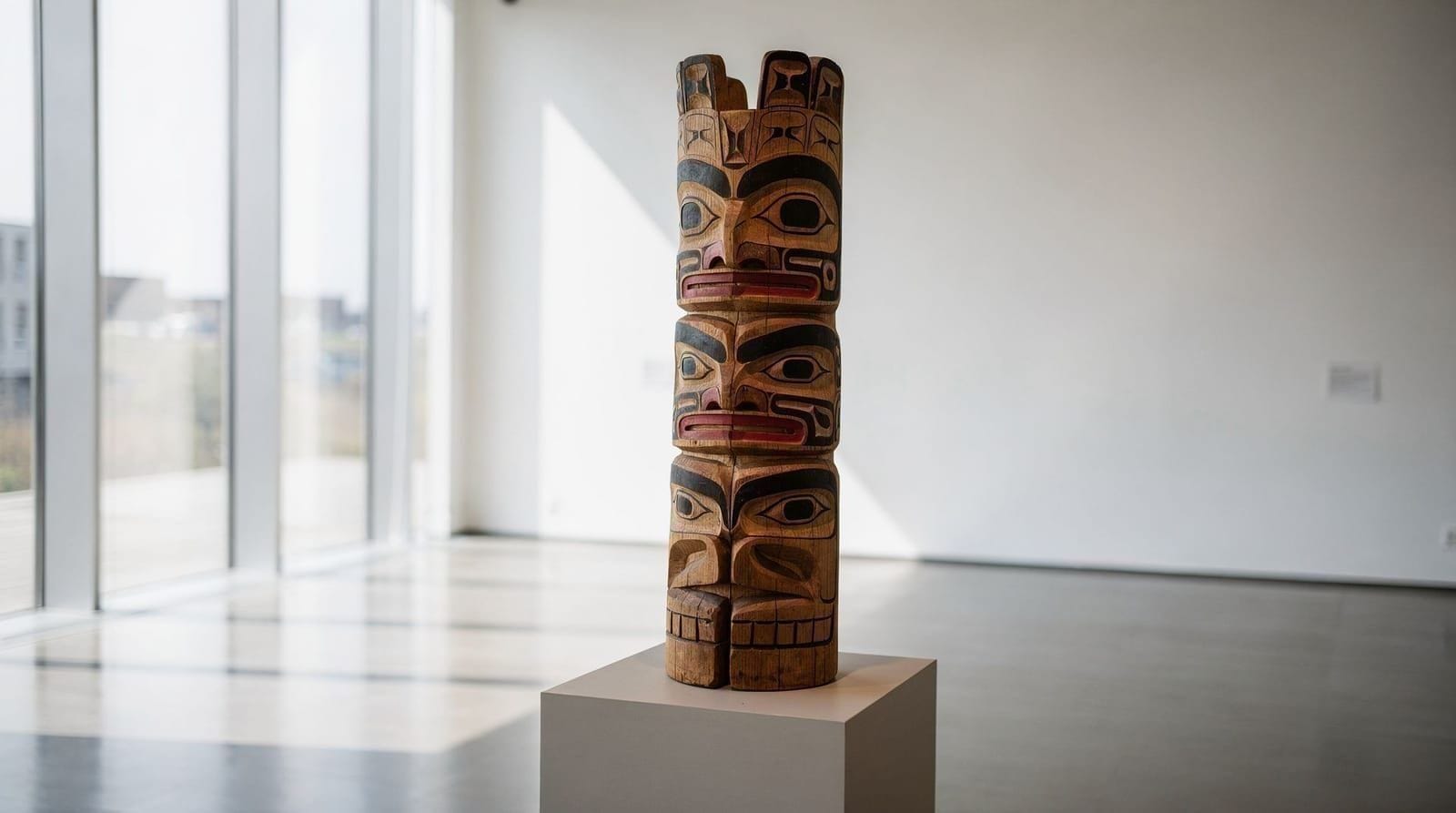
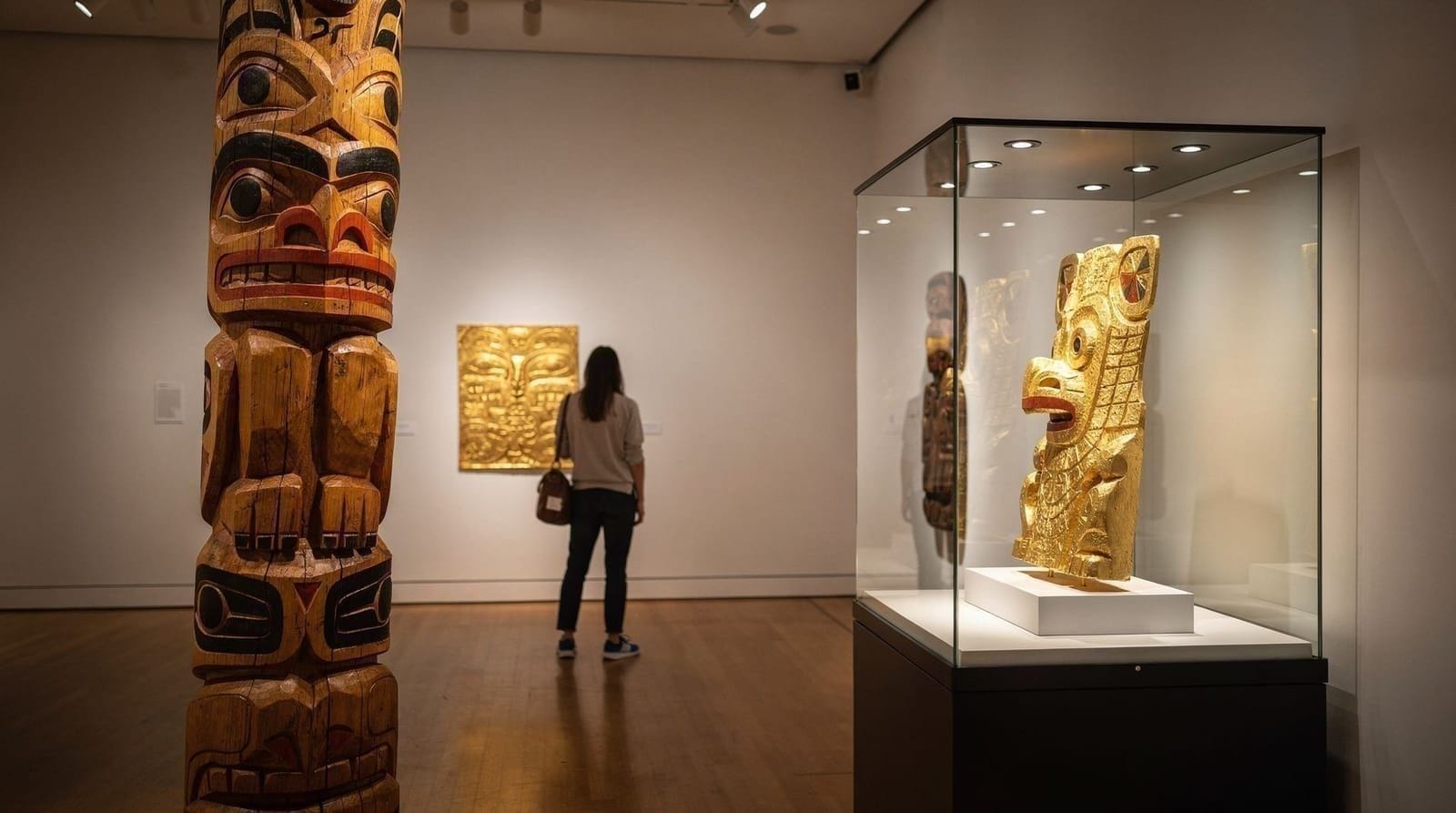
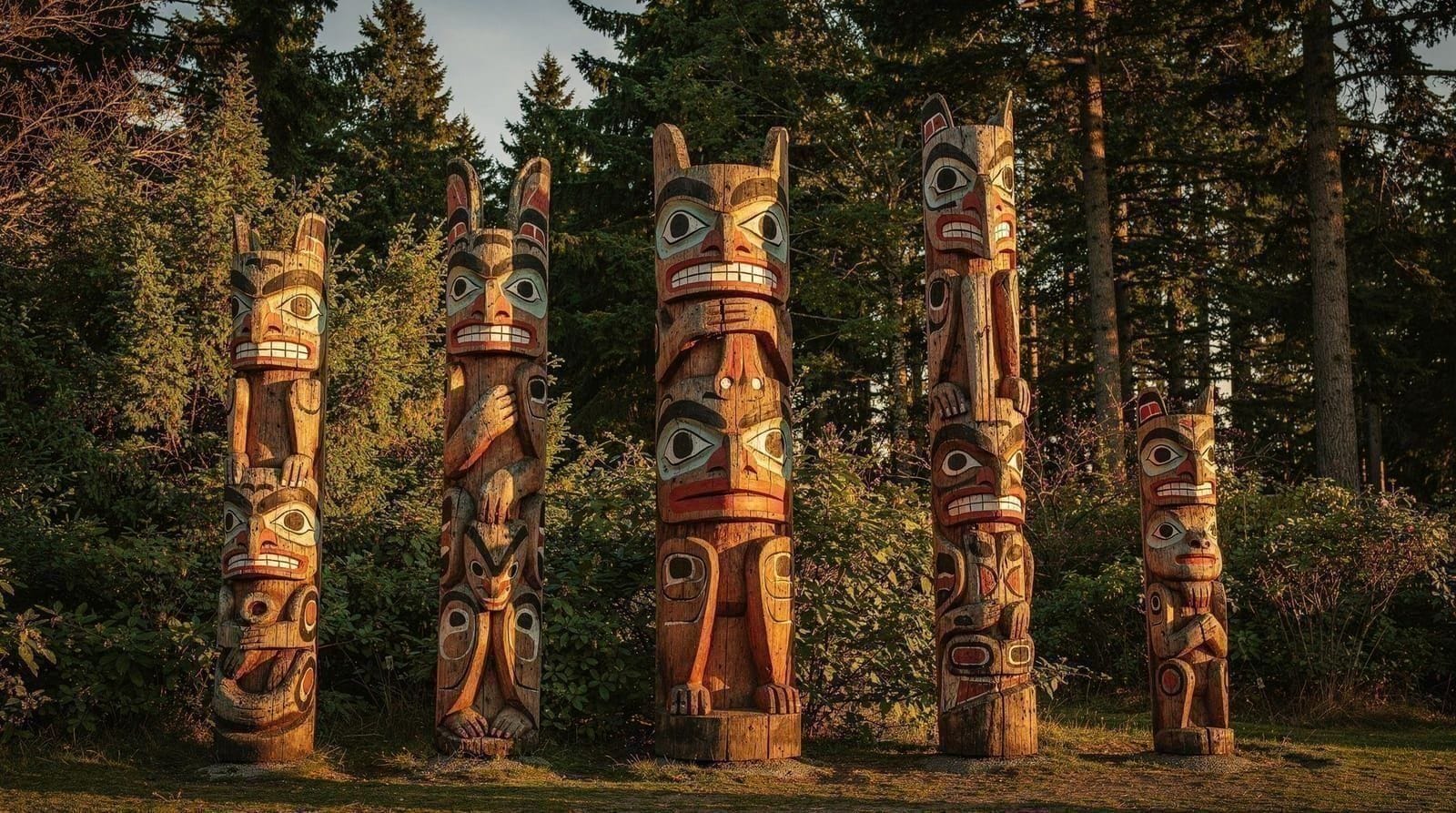
The Great Hall is MOA’s signature space and the one most visitors remember afterward — a soaring room housing large-scale totem poles, canoes, and carved house posts from multiple Northwest Coast Nations, arranged to be viewed from multiple angles and distances rather than lined up along a single wall. The scale here is genuinely different from smaller museum displays; several of the poles reach close to the room’s full height, and the natural light pouring through the glass wall changes the way the carvings read throughout the day.
The Bill Reid rotunda and other galleries
Beyond the Great Hall, MOA houses a rotating and permanent collection spanning Northwest Coast Nations well beyond the Great Hall’s carvings, plus a smaller but globally-focused collection representing cultures from around the world — part of the museum’s origin as a broader anthropology teaching collection for the university rather than a Northwest Coast-only institution. A notable Bill Reid piece, “The Raven and the First Men,” a large carved sculpture depicting a Haida creation story, sits in its own rotunda space and is one of the museum’s most recognizable single works, distinct from but complementary to the dedicated Bill Reid Gallery downtown.
Visible storage: the Multiversity Galleries
One of MOA’s more distinctive curatorial choices is its “visible storage” approach in the Multiversity Galleries, where thousands of additional objects are displayed in dense, glass-fronted cases rather than kept in inaccessible archival storage. It’s a different browsing experience than the curated Great Hall — closer to exploring an archive than viewing a traditional exhibit — and rewards visitors willing to spend real time working through the cases rather than moving quickly past.
Getting there
MOA sits on the UBC campus, west of downtown and outside the SkyTrain network, which surprises some visitors expecting all major Vancouver attractions to be reachable by rail. The most direct transit option is a bus — routes 44 and 84 both run from various downtown stops to UBC, taking roughly 30 to 40 minutes depending on traffic and covered by a standard Compass Card fare.
Driving is straightforward, with paid parking available on campus near the museum at rates comparable to downtown lots. For visitors who’d rather not manage transit connections themselves, a Museum of Anthropology and botanical gardens tour handles the whole visit, often pairing MOA with a nearby garden stop in the same outing.
Admission and hours
MOA charges standard museum admission, with rates around CAD 18 for adults, CAD 16 for students and seniors, and roughly CAD 47 for a family pass — reasonable value given the scale of the collection and building relative to some of the city’s other paid attractions. Hours vary seasonally and by day of the week, with Thursday evenings historically offering extended hours; checking the current schedule before visiting is worth doing since it isn’t open every day on a fixed year-round schedule the way some larger institutions are.
Notable individual pieces worth seeking out
Beyond Bill Reid’s “The Raven and the First Men,” a handful of other pieces in the collection reward specific attention. The museum’s collection of argillite carvings — a distinctive black stone worked primarily by Haida artists since the 19th century — represents a different scale and medium than the large-format totem poles dominating the Great Hall, worth seeking out in the smaller display cases for visitors interested in the range of Northwest Coast artistic traditions beyond monumental carving.
Several Musqueam and Coast Salish works displayed throughout the museum also offer a useful counterpoint to the more visually dominant northern-style formline carving that a first-time visitor might otherwise assume represents the whole of Northwest Coast art.
How much time to budget
Most visitors spend 2 to 3 hours at MOA to see the Great Hall, the Bill Reid rotunda, and a reasonable portion of the Multiversity Galleries without rushing. Visitors specifically interested in the visible-storage collection or attending a guided tour should budget closer to 3 hours, since the density of objects in that section alone can absorb considerably more time than a first-time visitor might expect.
Combining with the rest of campus
UBC’s campus offers several other worthwhile stops within a short walk or shuttle ride of MOA for visitors with extra time — the Nitobe Memorial Garden, a traditional Japanese garden, and the UBC Botanical Garden both sit nearby, and Wreck Beach, a clothing-optional beach at the base of the campus cliffs, is a distinctly different kind of Vancouver experience for visitors curious about it. None of these require advance planning beyond knowing they exist, making a full UBC-area day a reasonable extension of a MOA visit for travelers not on a tight schedule.
Where this fits in a broader cultural itinerary
Visitors building a day or two around Vancouver’s Indigenous and cultural institutions should read this guide alongside the First Nations experiences guide, which covers bookable, hands-on activities beyond the museum format, and Stanley Park’s own totem pole display, a free, more casual counterpoint to MOA’s dedicated academic depth. Together, the three give a genuinely rounded picture of how Indigenous culture and history show up across the city, from a major university museum to a free outdoor public site to guided, community-led experiences.
Who should prioritize this visit
MOA is a legitimate must-see for any visitor with an interest in Indigenous art, architecture, or Pacific Northwest history, not a niche academic detour. It’s a weaker fit for visitors with only a single free afternoon and a strong preference for downtown-based sightseeing, given the travel time required to reach campus, and those visitors are better served by the more centrally located Bill Reid Gallery if time is genuinely limited. For a broader look at how MOA fits into the region’s wider Indigenous cultural offerings, see the dedicated Indigenous culture in Vancouver guide.
A brief history of the collection
MOA’s origins trace back to UBC’s broader anthropology teaching collection, formalized into its own dedicated museum through the 1970s and given a defining architectural identity with Erickson’s 1976 building. Over the following decades, the museum’s relationship with the Nations whose material it holds has shifted considerably, moving from a more purely academic, collection-focused institution toward one actively engaged in repatriation efforts, collaborative curation with source communities, and ongoing dialogue about how Indigenous material culture should be displayed, interpreted, and, in some cases, returned.
That evolving relationship is itself part of what a thoughtful visit to MOA involves — understanding the museum not as a static archive but as an institution still actively working through its own history and responsibilities.
Repatriation and community collaboration
MOA has been more publicly engaged in repatriation than many peer institutions, working with various Nations to return specific items where requested and to co-curate exhibitions with community input rather than presenting collections purely through an academic, external lens. This context is worth knowing before a visit, since some exhibition text directly addresses these questions rather than presenting the collection as a neutral, settled historical record — a deliberate curatorial choice that distinguishes MOA from more traditional anthropology museums elsewhere.
Temporary exhibitions
Beyond its permanent Great Hall and Multiversity Galleries, MOA runs a rotating schedule of temporary exhibitions, often focused on contemporary Indigenous artists, specific Nations, or particular historical themes not covered in the permanent displays. These change throughout the year, so checking the current exhibition schedule ahead of a visit is worth doing for travelers with a specific interest, since a temporary show can meaningfully change what a visit offers beyond the well-known Great Hall and Bill Reid rotunda.
The gift shop
MOA’s on-site gift shop is a genuinely good source for authentic Indigenous art and craft, stocking work from artists connected to the museum’s broader network rather than the mass-produced “West Coast style” merchandise common in some downtown tourist shops. Prices reflect the quality and authenticity of the work rather than tourist-market pricing, and it’s a reasonable stop for visitors specifically looking to bring home a meaningful piece rather than a generic souvenir, covered in more detail in the Indigenous culture in Vancouver guide.
Accessibility and family visits
The museum is fully wheelchair accessible, with elevators connecting its various levels and wide pathways through both the Great Hall and Multiversity Galleries. Families with children generally find the Great Hall’s scale and visual impact engaging even for younger kids, though the more academic exhibition text throughout the museum is aimed at an adult and teen reading level. A family day pass at roughly CAD 47 is reasonable value for a family of four or more, undercutting the per-person adult rate meaningfully for larger groups.
Photography and what’s restricted
Photography is generally permitted throughout most of MOA’s public galleries, including the Great Hall, for personal, non-commercial use, though some specific pieces or temporary exhibitions may carry restrictions clearly posted at the item or gallery entrance. As with any Indigenous cultural site, some works carry cultural or ceremonial significance that makes photography inappropriate regardless of official policy, and paying attention to posted signage is the most reliable way to navigate this respectfully during a visit.
Comparing MOA to other anthropology museums
For visitors who’ve been to other major anthropology or ethnographic museums elsewhere in the world, MOA’s scale is smaller than the largest global institutions, but its focus and depth on Northwest Coast material specifically exceeds most general anthropology museums by a wide margin — this is the collection’s clear strength, rather than breadth across unrelated world cultures. Visitors expecting an encyclopedic global anthropology museum on the scale of the largest national institutions should adjust expectations accordingly; visitors specifically interested in Northwest Coast Indigenous art and material culture will find MOA among the strongest collections anywhere.
Guided tours vs self-guided visits
MOA offers docent-led tours at scheduled times, generally covering the Great Hall and Bill Reid rotunda in more depth than a self-guided visit would typically absorb on a first pass, drawing on specific training in the collection’s history and cultural context.
For visitors without the time or scheduling flexibility to catch a docent tour, a private Vancouver historical and heritage tour that includes MOA as one stop within a broader itinerary is a reasonable alternative, giving access to a knowledgeable guide without needing to align with the museum’s own internal tour schedule. Self-guided visits work well too, particularly for visitors who prefer to set their own pace and spend disproportionate time on whichever section most interests them rather than following a fixed narrative.
The totem poles outdoors
Beyond the Great Hall’s indoor collection, MOA maintains an outdoor area featuring additional totem poles and two reconstructed Haida houses, set against a backdrop of forest and, on clear days, mountain views. This outdoor component is often overlooked by visitors who treat the Great Hall as the museum’s endpoint, but it’s included in standard admission and worth the additional 20 to 30 minutes it takes to walk through, particularly for visitors interested in seeing how these structures and carvings were traditionally sited within a village context rather than a purely indoor museum setting.
Seasonal considerations
MOA is an indoor museum, making it a reliable option regardless of Vancouver’s notoriously changeable weather — a useful fact for travelers planning around a rainy stretch of their trip, since many of the city’s most popular outdoor attractions lose much of their appeal in poor weather. Summer visits can see higher crowd levels, particularly around midday, though MOA rarely reaches the crowding intensity of the city’s most heavily trafficked attractions like Capilano Suspension Bridge, given its location outside the main downtown tourist circuit.
Combining with UBC’s other cultural offerings
Travelers with a full day to dedicate to UBC’s west-campus attractions can reasonably combine MOA with the Beaty Biodiversity Museum, a natural history collection anchored by a full blue whale skeleton suspended in its atrium, offering a very different but complementary kind of museum experience within a short walk. Neither museum requires a full day individually, making the pairing a practical way to make the most of the transit or driving time already invested in reaching this part of the city.
The honest verdict
MOA rewards the trip west of downtown more consistently than almost any other single Vancouver attraction outside the core tourist zone — the combination of an architecturally significant building and a genuinely world-class Northwest Coast art collection is hard to match elsewhere in the city. Visitors who treat it as a 45-minute stop rather than budgeting a proper 2 to 3 hours tend to leave underwhelmed simply because they didn’t give the collection enough time; travelers who go in expecting a full, unhurried visit consistently rate it among the best things they did in Vancouver.
Membership and repeat visits
For travelers spending a longer stretch of time in Vancouver, or planning to return, MOA sells an annual membership that pays for itself after a couple of visits and includes discounts at the gift shop and invitations to members’ previews of new temporary exhibitions. It’s a reasonable option for local residents or long-stay visitors rather than a typical one-time tourist, but worth knowing about for anyone who suspects they’ll want to revisit given how much of the Multiversity Galleries alone can’t be fully absorbed in a single pass.
Frequently asked questions about Museum of Anthropology at UBC — what to see and how to plan your visit
Is MOA worth it if I’m short on time in Vancouver? Only if you can genuinely spare 2 hours minimum — a rushed 30-45 minute stop undersells the collection badly, and visitors on a tight schedule are often better served by the more centrally located Bill Reid Gallery instead.
Do I need to book tickets in advance? Not usually — walk-up admission is standard, though checking the current schedule matters since MOA isn’t open every day of the week and hours shift seasonally. Docent-led tours run at set times and may benefit from checking ahead.
Top experiences
Bookable activities with verified prices and instant confirmation on GetYourGuide.