Indigenous culture in Vancouver — museums, art, and experiences worth your time
Vancouver: Botanical Gardens Tour and Museum of Anthropology
Where can you experience Indigenous culture in Vancouver?
The Museum of Anthropology at UBC holds the region's largest collection of Northwest Coast Indigenous art and is the standard starting point. The Bill Reid Gallery downtown focuses specifically on Bill Reid and contemporary Northwest Coast artists, Stanley Park has several totem pole displays with interpretive signage, and a growing number of guided tours are led directly by Indigenous-owned operators and guides.
Vancouver sits on the unceded traditional territories of the Musqueam, Squamish, and Tsleil-Waututh Nations, and the region carries one of the richest concentrations of Northwest Coast Indigenous art and cultural institutions in Canada — a depth that surprises many first-time visitors who arrive expecting a handful of gift-shop totem poles rather than a genuinely serious museum and gallery scene.
For visitors, that presence shows up in a few clearly identifiable places — a major university museum, a focused downtown gallery, public art installations, and a growing number of guided experiences — rather than being spread thin across the city, which makes it possible to build a genuinely substantive visit around Indigenous culture without needing weeks to do it.
| Where | UBC (MOA), downtown (Bill Reid Gallery), Stanley Park |
| Cost | Free (Stanley Park) to ~CAD 18 (MOA); tours CAD 60-150+ |
| Time needed | 1-2 hours per stop, full day for all three |
| Getting there | Bus 44/84 to UBC; downtown sites walkable |
| Best time | Late February (Talking Stick Festival), June 21 |
The three host nations
Understanding who you’re learning about matters more here than in most city guides. The Musqueam (xʷməθkʷəy̓əm), Squamish (Sḵwx̱wú7mesh), and Tsleil-Waututh (səlilwətaɬ) Nations are the specific Coast Salish nations whose traditional and unceded territories overlap the city of Vancouver, and each has its own distinct language, governance, and cultural protocols. They’re collectively referred to as the Host Nations in most civic and tourism contexts.
It’s worth noting that a lot of the Northwest Coast art style visitors associate with the region — bold formline design, prominent totem poles — is historically more associated with Nations further north along the coast, including the Haida, Kwakwaka’wakw, and Tsimshian, whose work is heavily represented in Vancouver’s museums and public art alongside Coast Salish traditions, which have their own distinct visual language.
Museum of Anthropology at UBC
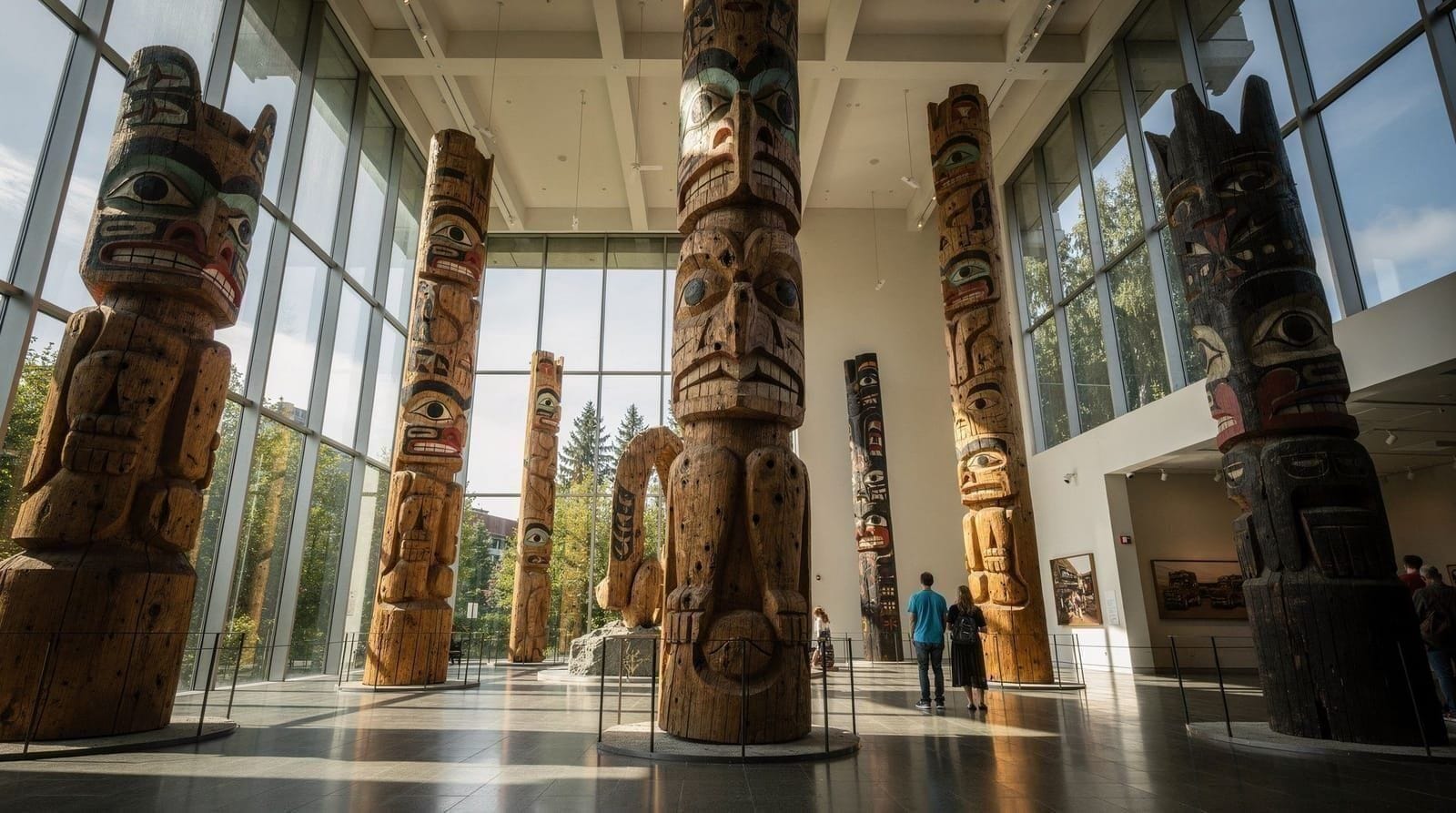
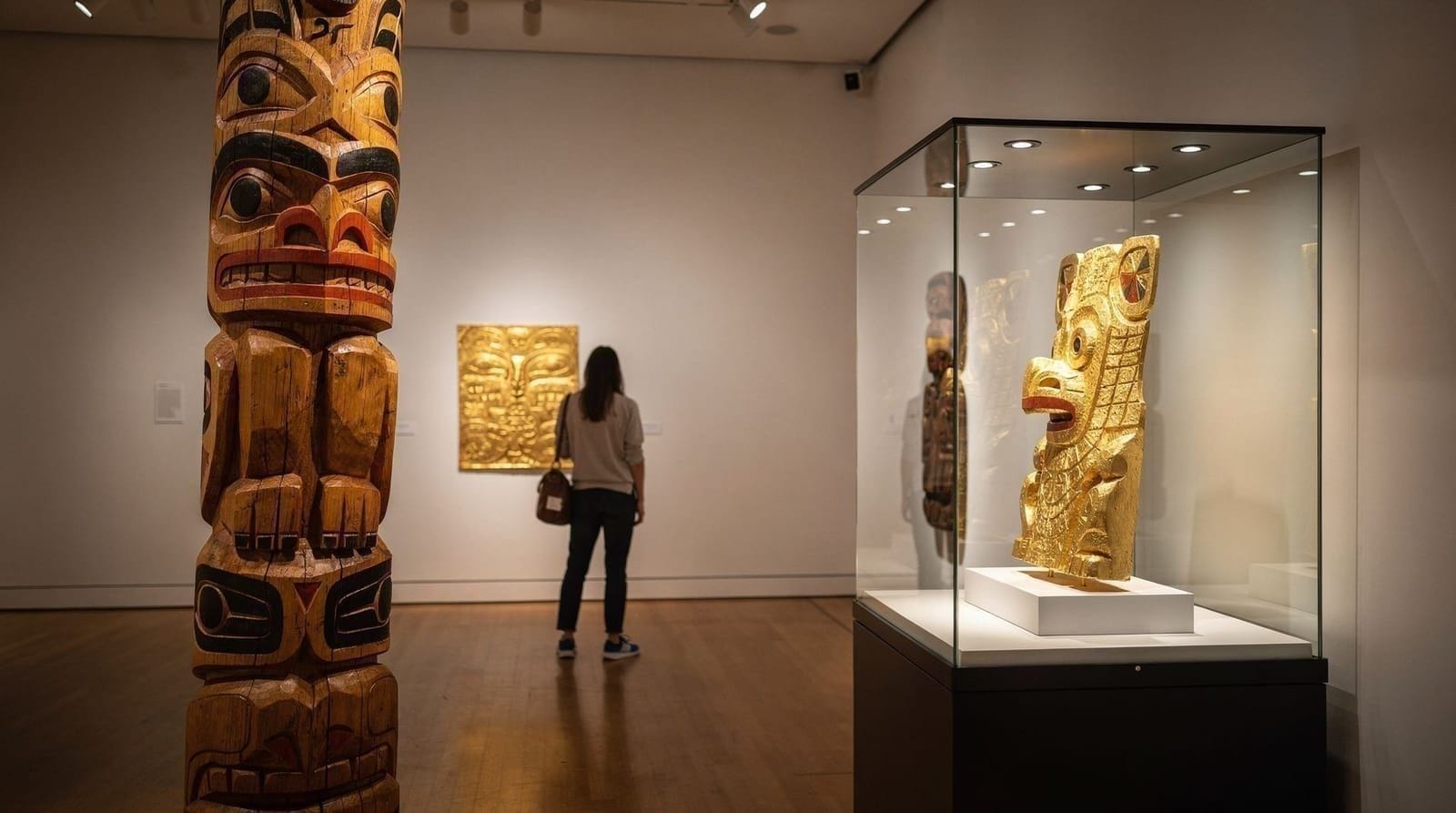
The Museum of Anthropology at the University of British Columbia holds the region’s most significant collection of Northwest Coast Indigenous art and material culture, housed in an architecturally notable building designed by Arthur Erickson that itself references post-and-beam Northwest Coast structures.
The Great Hall’s floor-to-ceiling windows and large-scale totem poles and carvings make it the most complete single stop for understanding the breadth of Northwest Coast artistic traditions, spanning multiple Nations rather than focusing narrowly on one. A guided Museum of Anthropology and botanical gardens tour combines the museum with VanDusen or a similar garden stop, useful for visitors without a car who want the visit handled without transit planning.
Bill Reid Gallery of Northwest Coast Art
Downtown, the Bill Reid Gallery is a smaller, more focused institution dedicated to Bill Reid — arguably the most influential Haida artist of the 20th century — and contemporary Northwest Coast Indigenous art more broadly. Its downtown location near Robson Square makes it easy to combine with a broader city walking day, and its smaller scale means a genuinely complete visit takes under an hour, in contrast to MOA’s larger collection, which rewards two or more hours.
Stanley Park’s totem poles
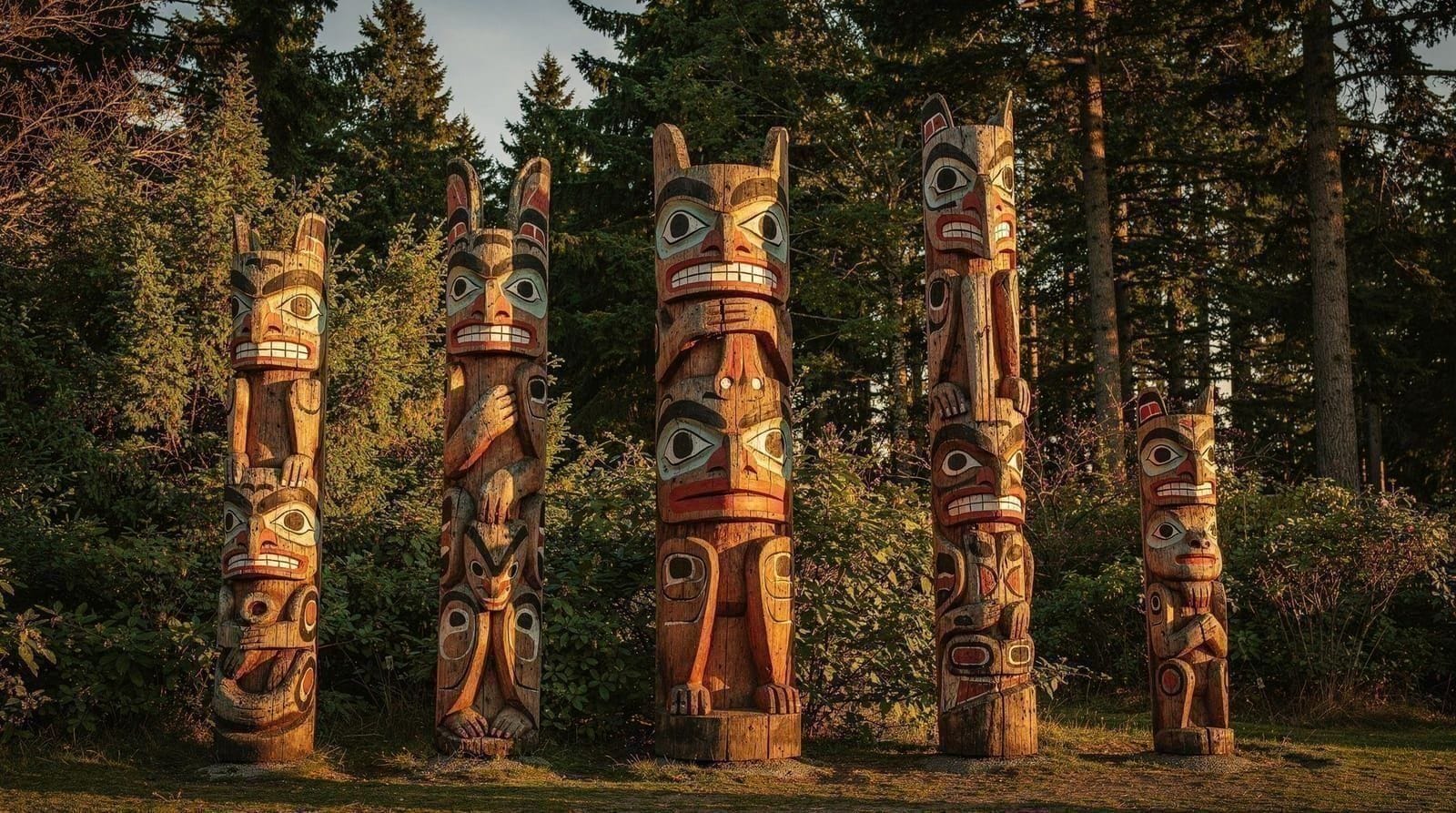
The totem pole display near Brockton Point in Stanley Park is one of British Columbia’s most-visited sites, free to view, and easily combined with a Seawall walk or a broader park visit covered in the Stanley Park guide. It’s worth understanding what’s actually there: most of the poles are not historical artifacts relocated from village sites, but works carved specifically for public display by artists from various coastal Nations, several replacing earlier poles that deteriorated or were themselves replicas. That doesn’t diminish their artistic value, but it’s a more accurate framing than assuming they represent an untouched historical site.
Guided experiences led by Indigenous operators
A growing number of guided tours in the region are owned and led directly by Indigenous guides and companies — Talaysay Tours, which runs Stanley Park walks and canoe experiences with Squamish and other local guides, is among the most established. These tours tend to offer a different register of information than a museum visit: oral history, plant knowledge, and cultural context delivered by someone speaking from their own Nation’s perspective rather than through interpretive signage.
For visitors specifically prioritizing Indigenous-led experiences over general sightseeing, seeking these operators out directly, rather than defaulting to the largest or most heavily marketed tour option, is worth the extra research. A private Vancouver historical and heritage tour is a useful complement for travelers who want a guide able to weave Indigenous history into a broader city narrative alongside colonial-era and contemporary Vancouver history, rather than focusing exclusively on one thread.
Capilano’s totem poles and cultural elements
Capilano Suspension Bridge Park, while a privately operated commercial attraction rather than an Indigenous cultural institution, includes a totem pole collection and has worked with local First Nations artists on some installations. It’s not a substitute for MOA or Bill Reid Gallery in terms of depth, but for visitors already planning a North Shore day around the bridge, it adds a cultural layer to what’s otherwise primarily a nature-and-views attraction. A Capilano Suspension Bridge ticket is worth booking ahead regardless of season given the park’s consistent crowds.
Public art around the city
Beyond the dedicated institutions, Indigenous public art appears throughout Vancouver in ways that reward attention rather than requiring a special trip. The Musqueam, Squamish, and Tsleil-Waututh welcome figures and carved works installed at Vancouver International Airport are among the first Indigenous artworks most visitors to the city encounter, often without realizing it. Downtown and around the Vancouver Convention Centre, several large-scale contemporary Indigenous sculptures and installations are integrated into the public realm rather than confined to gallery walls, making a walking tour of downtown public art a low-cost way to encounter contemporary Indigenous artistic practice alongside the more dedicated museum stops.
Combining these stops into a day
A full day dedicated to Indigenous culture in Vancouver works well starting with the Museum of Anthropology in the morning — it’s on the UBC campus, west of downtown, so an early start avoids doubling back — followed by lunch and an afternoon downtown covering the Bill Reid Gallery and nearby public art, with Stanley Park’s totem poles as a closing stop if time and energy allow, since the park sits between downtown and the North Shore. Visitors with less time should prioritize MOA if depth and scope matter most, or the Bill Reid Gallery and Stanley Park combination if a shorter, downtown-based visit fits the schedule better.
Getting to the Museum of Anthropology without a car
MOA sits on the UBC campus, west of downtown and outside the SkyTrain network, which catches some visitors off guard when planning transit. The most straightforward route is a direct bus from downtown — the 44 or 84 routes both run to UBC from various downtown stops, taking roughly 30 to 40 minutes depending on traffic and the specific starting point, and a standard Compass Card fare covers the trip.
Driving is also straightforward, with paid parking available on campus near the museum, running similar hourly rates to downtown lots. For visitors without the time or inclination to manage transit connections, the guided tour option covered above removes this planning step entirely, which is a meaningful part of its appeal for a one-off museum visit rather than a full day on campus.
Cost and time budget
Most of the sites covered here are inexpensive relative to Vancouver’s other paid attractions. Museum of Anthropology admission runs roughly CAD 18 for adults, CAD 16 for students and seniors, and around CAD 47 for a family pass, making it one of the better-value museum visits in the city relative to its scale. The Bill Reid Gallery charges a smaller admission fee, typically in the CAD 10 to 13 range.
Stanley Park’s totem poles and most public art around downtown are free to view. Guided Indigenous-led tours vary more widely, generally running from roughly CAD 60 for a shorter walking experience to over CAD 150 for a longer canoe-based or multi-stop tour, reflecting the smaller group sizes and more personalized format compared to a large commercial city tour.
Visiting respectfully
A few practices go a long way toward visiting these sites appropriately. Reading posted interpretive material rather than skimming past it changes what a totem pole or carved figure communicates from decorative backdrop to a specific work with a specific history and meaning.
Purchasing art or crafts directly from Indigenous-owned galleries and gift shops, rather than generic souvenir shops carrying mass-produced Northwest Coast-style patterns, is a concrete way to ensure spending supports the artists and communities whose work is being represented. And approaching guided experiences, particularly Indigenous-led ones, with genuine curiosity rather than treating them as a checklist item tends to produce a noticeably better experience for both visitor and guide.
Language and place names
Coast Salish languages are experiencing an active revitalization effort in the region, and visitors will increasingly encounter Musqueam, Squamish, and Tsleil-Waututh place names alongside or replacing English ones on signage, in museum materials, and in some civic communications.
The pronunciation guides included on most interpretive signage are worth reading rather than skipping past, since the names themselves — for landmarks, neighbourhoods, and natural features — often carry specific meaning tied to the land’s history that the English replacement names don’t convey. Squamish Nation’s territory, for instance, extends up the Sea-to-Sky corridor through Squamish and toward Whistler, which is reflected in place names and cultural sites well beyond the city itself.
Shopping for authentic Indigenous art
Vancouver has a real problem with mass-produced, non-Indigenous-made merchandise sold as “Native-inspired” or “West Coast style” souvenirs, particularly in high-traffic tourist areas like Gastown and around the cruise terminal. Buying directly from Indigenous-owned galleries — the Bill Reid Gallery’s own gift shop, the Museum of Anthropology’s shop, and dedicated Indigenous-owned galleries downtown and on Granville Island — is the most reliable way to ensure a purchase is both authentic and actually benefits the artist or community it represents.
Prices for genuine carved or woven work run considerably higher than the mass-produced alternatives, which is a reasonable reflection of the skill and time involved rather than inflated tourist pricing, and a fair trade-off for visitors who want a meaningful piece rather than a generic souvenir.
Seasonal events worth timing a visit around
The Talking Stick Festival, typically held in late February, is Vancouver’s major annual celebration of Indigenous performing arts, bringing together dance, theatre, music, and storytelling from Nations across Canada, and it’s one of the more substantive ways to experience contemporary Indigenous culture beyond the museum context. National Indigenous Peoples Day, observed June 21st, brings public events, performances, and gatherings across the city, including at various Vancouver Park Board sites and the Museum of Anthropology. Visitors whose trip dates happen to align with either event should treat it as a genuine highlight worth adjusting an itinerary around, rather than a minor scheduling footnote.
Beyond the city: the Squamish Lil’wat Cultural Centre
Travelers extending their trip toward Whistler or the Sea-to-Sky corridor have a further option worth knowing about: the Squamish Lil’wat Cultural Centre in Whistler Village, a partnership between the two Nations whose traditional territories meet in that area.
It’s a smaller, more contained institution than the Museum of Anthropology, but its focus on two specific, neighbouring Nations — rather than a broad regional survey — offers a different and complementary kind of depth, including guided tours led by Squamish and Lil’wat cultural ambassadors. Visitors doing a Whistler day trip or staying longer in the corridor should factor in an hour or two here alongside the more typical mountain-focused activities.
What museums and tours in this list get right and wrong
Museum of Anthropology-style institutions do the scholarly and archival work well — provenance, historical context, and the sheer scale of what’s on display are genuinely impressive, and MOA in particular has worked over decades to build stronger relationships with the Nations whose material it holds, including repatriation efforts for some items.
Where museum-format visits inherently fall short is in delivering a living, first-person cultural perspective; that’s precisely the gap that Indigenous-owned and Indigenous-led tour operators are positioned to fill, and it’s worth treating the two as complementary rather than redundant. A visitor who only does the museum circuit gets the historical and artistic depth without the lived, contemporary perspective; a visitor who only does a guided walking tour gets the opposite. Combining both, even briefly, gives a more complete picture than either alone.
Further reading before you go
For visitors who want context before arriving rather than absorbing everything on-site, a small amount of pre-trip reading changes the museum and gallery visits considerably. The Musqueam, Squamish, and Tsleil-Waututh Nations’ own websites all publish accessible material about their history, governance, and current initiatives, and are a more direct source than most general tourism materials. The Museum of Anthropology’s own published guides and the Bill Reid Gallery’s exhibition materials are similarly good starting points, written for a general audience without requiring an academic background in anthropology or art history.
How this fits with the rest of a Vancouver cultural itinerary
Indigenous cultural sites pair naturally with the rest of Vancouver’s history-focused stops rather than sitting in isolation. A day that includes the Museum of Anthropology or Bill Reid Gallery alongside Gastown’s colonial-era history or Chinatown’s own layered history gives a more complete picture of the region’s past than any single stop can — the city’s Indigenous history predates, and continues alongside, the 19th-century settlement history that Gastown and Chinatown more typically represent.
For visitors specifically interested in bookable, guided cultural experiences beyond the museum circuit, the dedicated First Nations experiences guide covers a wider range of hands-on options, including canoe tours and workshops, than this overview can fit in full.
What this looks like for a family visit
Families visiting with children generally find the Museum of Anthropology’s Great Hall and outdoor totem poles engaging even for younger kids, thanks to the scale and visual impact of the carvings, though the museum’s more academic exhibition text is aimed at adult and teen readers. Stanley Park’s totem poles work well as a shorter, free stop that doesn’t require the sustained attention span a full museum visit demands. Talaysay Tours and similar Indigenous-led experiences in Stanley Park are often specifically well suited to families, since storytelling and interactive elements tend to hold children’s attention better than a self-guided museum walk.
The honest verdict
Vancouver’s Indigenous cultural offerings are substantive enough to build a full, worthwhile day around, and the Museum of Anthropology in particular is a legitimate must-see for any visitor with an interest in Northwest Coast art or history, not just a niche add-on. What’s worth avoiding is treating the more casual encounters — Stanley Park’s totem poles, gift-shop Northwest Coast-style merchandise — as a complete substitute for the museums and guided experiences that provide real depth and context; the former are a reasonable introduction, but visitors who stop there get a much thinner picture than the city’s actual cultural institutions offer.
Frequently asked questions — Indigenous culture in Vancouver
Whose traditional territory is Vancouver on?
Vancouver sits on the unceded traditional territories of the Musqueam (xʷməθkʷəy̓əm), Squamish (Sḵwx̱wú7mesh), and Tsleil-Waututh (səlilwətaɬ) Nations, who are collectively referred to as the Host Nations in the region's tourism and civic materials. Acknowledging this is standard practice at cultural sites, public events, and increasingly on tourism materials across the city.What's the difference between the Museum of Anthropology and the Bill Reid Gallery?
The Museum of Anthropology (MOA) is a large university museum with a broad collection spanning many Northwest Coast Nations plus global holdings, housed in an architecturally significant Arthur Erickson building at UBC. The Bill Reid Gallery is a smaller, downtown gallery focused specifically on Bill Reid's work and contemporary Northwest Coast Indigenous art, making it a faster visit for anyone short on time.Are there Indigenous-owned or Indigenous-led tours in Vancouver?
Yes — Talaysay Tours and similar Indigenous-owned operators run guided walks and canoe experiences in Stanley Park and around the North Shore, led by Squamish, Musqueam, or other local Nations' guides. Booking directly with an Indigenous-owned operator, where available, is generally the most direct way to ensure tourism spending reaches the community whose culture and territory is being presented.Can you see totem poles in Vancouver without visiting a museum?
Yes — Stanley Park's totem pole display near Brockton Point is a free, outdoor collection that's one of the most-visited sites in British Columbia, though it's worth knowing that most of the poles there are replicas or were carved by artists from various coastal Nations specifically for public display rather than being historical originals moved from village sites.Is it appropriate to take photos at Indigenous cultural sites?
Generally yes at public displays like the Stanley Park totem poles and museum exhibits designed for public viewing, but it's worth reading posted signage carefully, since some ceremonial items, sacred objects, or specific artworks are restricted from photography out of respect for their cultural significance. Guided tours will typically clarify what is and isn't appropriate to photograph as part of the experience.What should visitors know before visiting Indigenous cultural sites in Vancouver?
The most useful starting point is understanding that "Indigenous culture" in the Vancouver region isn't a single, uniform tradition — the Musqueam, Squamish, and Tsleil-Waututh are distinct Nations with their own languages, protocols, and histories, and Northwest Coast art styles associated with more northern Nations (Haida, Kwakwaka'wakw) are often what's most visible in gift shops and public art, which can blur those distinctions for visitors unfamiliar with the region.
Top experiences
Bookable activities with verified prices and instant confirmation on GetYourGuide.