Granville Island artisans — the studios and makers behind the market
Vancouver: Granville Island Market Tour with Tastings
Duration: 2 hours
What artisan studios can you visit on Granville Island?
Granville Island has a genuine working artist community beyond the Public Market — glassblowing studios, ceramics workshops, printmakers, and the Granville Island Art Gallery, many with open studios where visitors can watch artists at work. The Net Loft building and the studios along the island's south side hold the highest concentration.
Most visitors know Granville Island for its Public Market, but the island’s identity as an arts and crafts hub runs deeper than the produce stalls and prepared-food vendors — a genuine community of working artists and makers operates in studios scattered across the island, many open to the public, offering a different and less crowded side of a Granville Island visit.
| Where | Net Loft building and studios along the island’s south side |
| Cost | Free to browse; pieces from around CAD 30-60 up |
| Time needed | 1 extra hour beyond the market, more for workshops |
| Best time | Weekday mornings, before the market’s midday peak |
| Getting there | Aquabus/False Creek Ferries or a short walk over the bridge |
Vancouver’s broader craft and market culture, also visible at Granville Island Market and in the city’s food-tour scene covered in the Vancouver food tours guide, finds its most concentrated artisan expression here, where working studios sit steps away from the market stalls most visitors come specifically to see.
From industrial site to arts hub
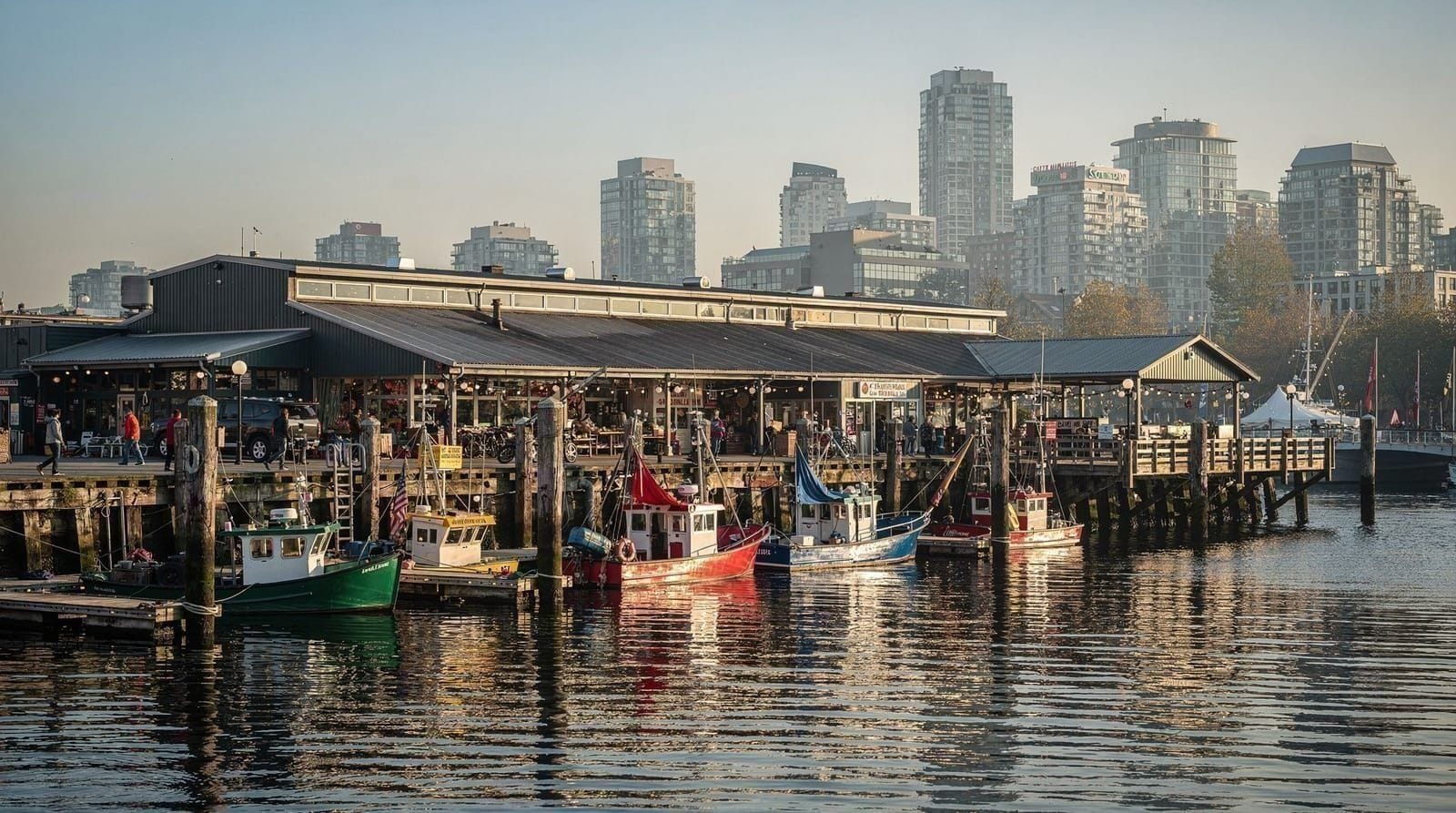
Granville Island’s current identity as an arts and market district is a relatively deliberate late-20th-century transformation of what was, for decades, a working industrial area — sawmills, a chain and cable factory, and other heavy industry operated here through much of the early and mid-20th century, leaving behind the corrugated metal warehouse buildings that still define the island’s architectural character today.
Federal redevelopment starting in the 1970s converted these industrial structures into the market, studios, and public spaces visitors see now, deliberately preserving the raw, industrial aesthetic rather than demolishing it in favour of a more conventional retail development — a choice that gives the island its distinctive look, all exposed metal siding and repurposed warehouse interiors rather than a manicured shopping district.
The Net Loft and studio buildings
The Net Loft building, near the market’s entrance, houses some of the island’s most accessible artisan shops and studios, focused on textiles, paper goods, jewelry, and design work. Beyond the Net Loft, studios housed in the former industrial buildings along the island’s south and west sides include working glassblowing studios, ceramics workshops, and printmaking spaces, many operating with viewing areas or open-studio policies that let visitors watch the actual production process rather than only browsing finished pieces.
How much time to budget for the studios
Beyond the market itself, which most visitors cover in an hour or two, budgeting an additional hour to properly explore the Net Loft and the studio buildings along the island’s south side gives a more complete sense of what’s on offer without feeling rushed. Visitors specifically planning a glassblowing demonstration, a hands-on workshop, or a longer conversation with a particular artist should allow more time still, since these interactions don’t fit neatly into a quick browse-and-move-on itinerary the way a market stall visit typically does.
Glassblowing on the island
Granville Island’s glassblowing studios are among its most popular artisan draws, offering visitors a chance to watch molten glass being shaped in real time — a genuinely mesmerizing process for anyone who hasn’t seen it done live before. Some studios also offer hands-on glassblowing experiences for visitors wanting to try the craft themselves under an artist’s direct supervision, generally requiring advance booking given the specialized equipment and one-on-one instruction involved. Finished pieces, from small decorative items to larger sculptural work, are typically sold directly through the studio, giving buyers a direct connection between the artist and the piece rather than a gallery intermediary.
Ceramics and pottery studios
Several working ceramics studios operate on the island, ranging from functional tableware production to more sculptural and decorative work, and many welcome visitors to observe wheel-throwing or hand-building in progress. As with the glassblowing studios, buying directly from the maker gives visitors both a meaningful souvenir and direct insight into the process behind it, a different experience than purchasing similar items through a general gift shop elsewhere in the city.
The Granville Island Art Gallery and Federation of Canadian Artists
Beyond individual studios, the Granville Island Art Gallery, operated by the Federation of Canadian Artists, exhibits and sells work from its member artists across painting, sculpture, and mixed media, offering a broader survey of the island’s and the wider region’s contemporary artistic community in a single space. It’s a useful stop for visitors who want to see a curated cross-section of local work without visiting individual studios one by one.
Combining artisan studios with the market
Because the Public Market draws the bulk of Granville Island’s foot traffic, the artisan studios tend to be considerably less crowded, even during the market’s busiest hours — a genuine advantage for visitors who find the market itself overwhelming on a peak summer day.
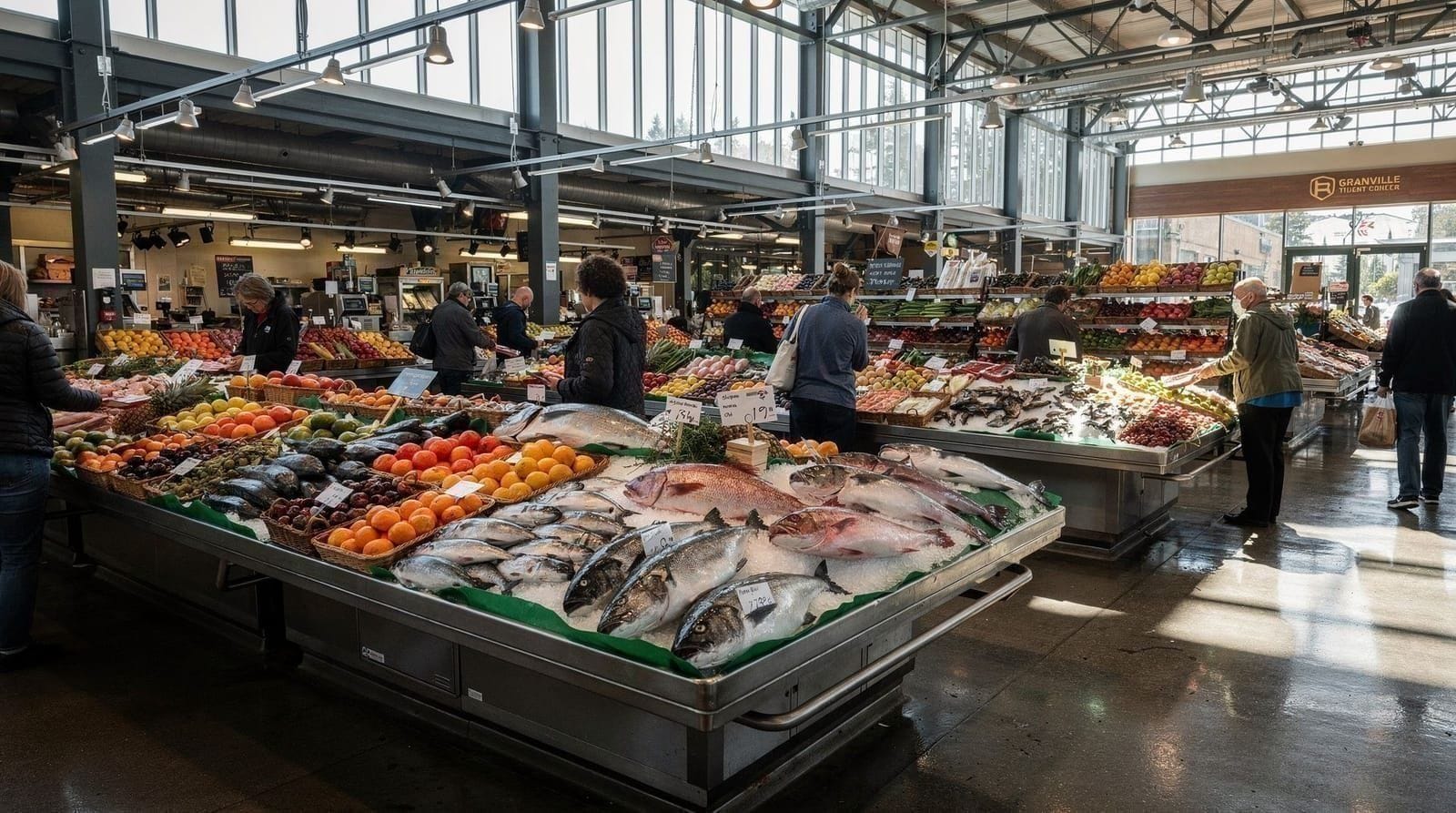
A Granville Island market tour with tastings covers the food side of the island in depth, and pairing it with independent time exploring the studios afterward gives a fuller picture of the island than the market tour alone. For a broader walking overview that touches on both, a Granville Island food walking tour is a reasonable starting point before branching off to the studios independently.
Granville Island Brewing
While not a craft studio in the artisan sense, Granville Island Brewing — Canada’s first modern microbrewery, operating since 1984 — is part of the same broader maker-and-craft identity that defines the island, and its on-site tours and tasting flights are a popular complement to a studio-focused visit for beer-interested travelers. It’s worth treating as a separate category from the visual-arts studios, but thematically connected to the island’s overall celebration of small-scale, hands-on production.
Public art and outdoor installations
Beyond the indoor studios, Granville Island incorporates public sculpture and outdoor installations throughout its walkways and waterfront areas, some created by artists connected to the island’s studios and its former Emily Carr University presence. These are easy to walk past without noticing amid the market’s foot traffic, but worth deliberately looking for during a studio-focused visit, since they extend the island’s maker identity into its public spaces rather than confining it strictly to the indoor gallery and studio buildings.
Getting there without a car
Granville Island’s small passenger ferries — the little Aquabus and False Creek Ferries boats — connect the island to Yaletown, Kitsilano, and other False Creek-adjacent neighbourhoods, a genuinely pleasant and quick way to arrive that doubles as a mini harbour tour. Driving is also an option, though parking on the island itself is limited and can fill on busy weekends, making the ferry or a short walk from nearby neighbourhoods the more reliable option during peak season.
Best time to visit the studios
Weekday mornings offer the quietest browsing conditions for the artisan studios specifically, well before the market’s midday peak crowds arrive. Many individual studios keep somewhat variable hours compared to the market’s consistent daily schedule, so visitors with a specific studio or artist in mind should check current hours directly rather than assuming uniform opening times across the island.
Emily Carr University’s legacy on the island
For decades, Emily Carr University of Art + Design — named for the same painter whose work anchors much of the Vancouver Art Gallery’s permanent collection — operated its main campus directly on Granville Island, a significant part of why the island developed such a concentrated artist community in the first place. The university relocated to a new, larger campus on Great Northern Way in 2017, and its departure changed the island’s character somewhat, though the studios, galleries, and maker spaces that grew up around decades of art students and graduates remain, giving the island’s current artisan community a direct lineage back to that institutional presence even after the school itself moved on.
Printmaking and paper artisans
Beyond glass and ceramics, several printmaking studios on the island produce limited-edition prints using traditional techniques — etching, lithography, and screen printing among them — offering a different kind of collectible artwork than the more immediately tactile glass and ceramic pieces. The Net Loft building in particular houses several paper-focused makers, from hand-bound journals to letterpress stationery, appealing to visitors looking for a smaller, more packable souvenir than a piece of glasswork or pottery.
Wood and furniture makers
A smaller number of woodworking and furniture studios round out the island’s craft community, producing everything from small decorative items to larger custom furniture pieces, generally requiring more advance coordination for visitors interested in a serious purchase rather than a casual browse. These studios tend to be less immediately visible than the glassblowing and ceramics spaces, often tucked into quieter corners of the industrial buildings away from the main pedestrian flow near the market.
Kids and family workshop options
Some studios on the island offer family-friendly, shorter-format workshops — a simplified pottery or glass experience suited to children, distinct from the more involved professional-level instruction offered to serious hobbyists or adult visitors. These are worth seeking out specifically for families wanting a hands-on creative activity beyond simply watching artists work, though availability and age minimums vary by studio and are worth confirming directly before planning a visit around one.
Seasonal art walks and events
Granville Island periodically hosts dedicated art walks and open-studio events, when normally private or less-visible studio spaces open more broadly to the public and artists are more readily available to discuss their work directly with visitors. These events don’t run on a single fixed annual date, so checking the island’s current event calendar ahead of a visit is worth doing for travelers specifically hoping to catch one, since the atmosphere during a dedicated art walk is noticeably different from the island’s typical daily rhythm.
Shopping tips for authentic work
As with any concentrated tourist destination, Granville Island includes some shops selling imported or mass-produced items alongside the genuine artisan studios, and it’s worth learning to distinguish between them — a piece sold directly through a working studio, often with the maker present or nearby, is a more reliable indicator of authenticity than an item in a general gift shop stocking a mix of local and imported goods. Asking directly where and by whom a piece was made is a reasonable and normal question in this kind of maker-focused environment, and most genuine artisan studios welcome the conversation.
Comparing to Vancouver’s other craft and design scenes
Granville Island’s concentration of working studios distinguishes it from most of Vancouver’s other shopping and design-focused areas, including Gastown’s mix of boutique retail and Main Street’s vintage and independent design shops, both of which lean toward selling finished goods rather than offering the direct maker access Granville Island provides. Visitors specifically interested in watching a craft being made, rather than simply shopping for finished pieces, will find Granville Island the clearest single destination in the city for that experience, concentrated within a compact, walkable area rather than scattered across multiple neighbourhoods.
The trolley tour option
For visitors who want a guided overview of the island that includes context on its artistic and industrial history alongside the market itself, a Granville Island sightseeing trolley tour combines a broader city overview with a dedicated island stop, useful for travelers who want the historical framing delivered directly rather than piecing it together independently while browsing.
The False Creek setting
Granville Island’s setting beneath the Granville Street Bridge, surrounded by False Creek’s waterway, is itself part of what makes the island’s industrial-to-artisan transformation feel coherent rather than arbitrary — the working harbour atmosphere, complete with actual boat traffic and the small passenger ferries crossing constantly, reinforces the sense of a still-functioning maritime and industrial site rather than a purely themed retail development built to resemble one. Visitors arriving by the Aquabus or False Creek Ferries get the clearest sense of this context, approaching the island from the water rather than driving in directly.
A brief note on the island’s name
Despite being called an island, Granville Island is technically a peninsula, connected to the mainland by a narrow strip of land beneath the Granville Street Bridge — a detail that surprises some first-time visitors expecting a genuine water crossing to reach it by land. The name predates the site’s current form, dating back to its industrial-era development in the early 20th century, and has simply stuck through the decades of subsequent transformation, including the recent artisan and market-focused redevelopment covered throughout this guide.
Extending a visit toward Kitsilano
Given its proximity, Kitsilano makes a natural extension for visitors who’ve spent a morning or early afternoon exploring Granville Island’s studios and market, reachable by a short ferry ride or walk across the Burrard Street Bridge. Kitsilano’s own beach and cafe culture offers a change of pace after a studio-and-market-focused morning, rounding out a full day on this side of the city without requiring a significant additional transit commitment.
Where this fits in a broader Vancouver trip
Granville Island, studios included, appears as a standard stop in most first-time Vancouver itineraries, including day two of the 3-day Vancouver plan and the broader first-time Vancouver guide, both of which pair a Granville Island morning with a Yaletown or Gastown afternoon. Visitors specifically prioritizing the food side of the island over the artisan studios should read the Granville Island food guide alongside this one, since the two guides split the island’s two main draws — food and craft — into separate, focused overviews.
Textile and fibre artists
Beyond paper and print, a handful of Granville Island studios specialize in textile and fibre work — weaving, natural dyeing, and hand-knitted or hand-woven pieces produced on-site rather than sourced from wholesale suppliers. These studios tend to run smaller and quieter than the more visually dramatic glassblowing spaces, appealing especially to visitors with a specific interest in traditional textile techniques or those looking for a genuinely handmade wearable piece rather than a purely decorative object. Several also sell smaller-format goods, like hand-dyed scarves or woven table linens, that pack more easily into travel luggage than glass or ceramic work.
Jewelry makers and metalwork
A cluster of jewelry studios and metalwork artisans round out the island’s craft offering, working in silver, gold, and mixed materials, often drawing stylistically from the broader Pacific Northwest design language visible elsewhere in the city’s art scene, including the Northwest Coast Indigenous formline tradition covered in the Bill Reid Gallery guide, though most Granville Island jewelry studios work in a distinct, non-Indigenous contemporary design tradition rather than that specific artistic lineage.
Custom commission work is available through several studios for visitors with more time and a specific piece in mind, generally requiring a return visit or shipping arrangement given the production time involved.
Pricing expectations
Prices for genuine studio-made work vary widely by medium and maker, but as a rough guide, smaller glass or ceramic pieces commonly start around CAD 30-60, with larger sculptural or functional pieces climbing into the low hundreds. Custom or commissioned work runs higher still, reflecting the maker’s time and the piece’s uniqueness. This pricing sits above what a mass-produced souvenir costs, and it’s worth setting that expectation before browsing — the premium reflects direct, small-batch craftsmanship rather than markup on an imported item, and most visitors find the price difference easy to justify once they understand what they’re actually buying.
A studio-focused half-day itinerary
Visitors specifically prioritizing the artisan side of Granville Island over the market can build a satisfying half-day around it: start at the Net Loft for textiles, paper, and jewelry, move to the glassblowing studios along the south side for a demonstration, continue to a ceramics studio to watch wheel-throwing in progress, and finish at the Granville Island Art Gallery for a broader curated survey of local work. This route deliberately minimizes time in the Public Market’s busiest aisles, better suited to visitors who’ve already done a market-focused visit on a previous trip or who simply prefer the quieter studio side of the island on this particular outing.
The honest verdict
Granville Island’s artisan studios are the part of the island most visitors miss entirely, drawn in by the Public Market and rarely venturing beyond it to the quieter studio buildings nearby. For visitors with an interest in craft, design, or simply watching skilled work happen in real time, the studios offer a genuinely different and less crowded experience than the market, and buying directly from a working artist gives a souvenir with a story attached rather than a generic gift-shop purchase. A Granville Island visit that skips the studios entirely gets only half the island’s actual identity.
Frequently asked questions about Granville Island artisans — the studios and makers behind the market
Do I need to pay to enter the artisan studios?
No — browsing the Net Loft and the open studios along the island’s south side is free. You only pay if you buy a piece or book a hands-on workshop, and most glassblowing or ceramics demonstrations are free to watch through viewing windows.
Is Granville Island worth visiting just for the studios, without the market?
Yes for anyone specifically interested in craft or design — the studios are quieter than the market and give a genuinely different sense of the island, though most visitors still combine both in the same visit since they sit steps apart.
Top experiences
Bookable activities with verified prices and instant confirmation on GetYourGuide.