Tofino trip from Vancouver — why it's not a day trip and how to plan it
Vancouver to Tofino 2 Day Tour (Private)
- Private tour
Can you visit Tofino as a day trip from Vancouver?
Not realistically. The drive alone runs 5.5 to 6.5 hours one way including a BC Ferries crossing, which makes a same-day round trip over 11 hours of travel for little actual time in Tofino. Flying cuts travel to about an hour each way and is the only way to make a single-day visit workable, though most visitors plan at least one overnight.
Tofino appears on a lot of Vancouver day-trip search lists, and it’s worth saying plainly up front: it isn’t a realistic single-day trip by road, and treating it as one leads to a genuinely exhausting travel day for very little time at the destination. This guide covers why, what the real travel options look like, and how to plan a Tofino visit that actually works.
| Distance | ~330km, but 5.5–6.5hrs one way by road + ferry |
| Time needed | Minimum 2 days, 1 night |
| Cost | Ferry around CAD 16–75 + accommodation CAD 180–400+/night |
| Getting there | Drive + BC Ferries, or ~1hr flight |
| Best time | June–September for whales and dry weather |
Why Tofino isn’t a day trip
Tofino sits on the west coast of Vancouver Island, roughly 330 kilometres from Vancouver by the shortest practical road route — but that distance understates the real travel time, because reaching Vancouver Island requires a ferry crossing first.
The standard route runs BC Ferries from Tsawwassen to Duke Point near Nanaimo (about 2 hours), then a drive across the island via Port Alberni and the winding, mountainous Highway 4 to the coast (roughly 3 to 3.5 hours from the ferry terminal). All told, door to door, that’s 5.5 to 6.5 hours one way — meaning a same-day round trip would mean 11-plus hours of travel for a few hours in Tofino at most, before accounting for any delays, ferry waits, or rest stops along a genuinely demanding driving route.
The realistic ways to get there
Flying is the only method that makes a single-day visit plausible. Small regional carriers operate scheduled flights between Vancouver (YVR or the South Terminal) and Tofino’s small airport, taking around 45 minutes to an hour in the air. It’s considerably more expensive than driving and subject to weather-related delays given Tofino’s exposed coastal location, but it turns an 11-hour round-trip ordeal into a manageable day, assuming flight schedules align with your other plans.
Driving remains the most common approach for visitors planning to stay at least one night, and it’s worth treating the drive itself as part of the experience rather than pure transit — the crossing of Vancouver Island via Highway 4 passes through old-growth forest, including the popular Cathedral Grove stop near Port Alberni, and the descent into Tofino along the coast offers some of the most dramatic scenery on the whole route.
For travelers who’d rather not manage the ferry booking, the long drive, and the logistics themselves, a private 2-day Tofino tour from Vancouver handles the entire route, typically with an overnight included, removing the need to plan ferries or navigate Highway 4 independently.
What a realistic itinerary looks like
Given the travel time involved, the practical minimum for a worthwhile Tofino visit is two days and one night — a full travel day each way isn’t required if you’re efficient, but trying to compress meaningful time in Tofino into anything less than an overnight generally isn’t worth the effort of getting there.
A two-day version typically means an early departure from Vancouver, arrival in Tofino by mid-afternoon, an evening and following morning to actually experience the coast — beaches, a rainforest walk, whale watching or a hot springs boat trip — before the return journey. Visitors with three days or more get considerably more value out of the trip, since it allows a full day without any travel pressure sandwiched between the two travel days.
What to actually do once you’re there
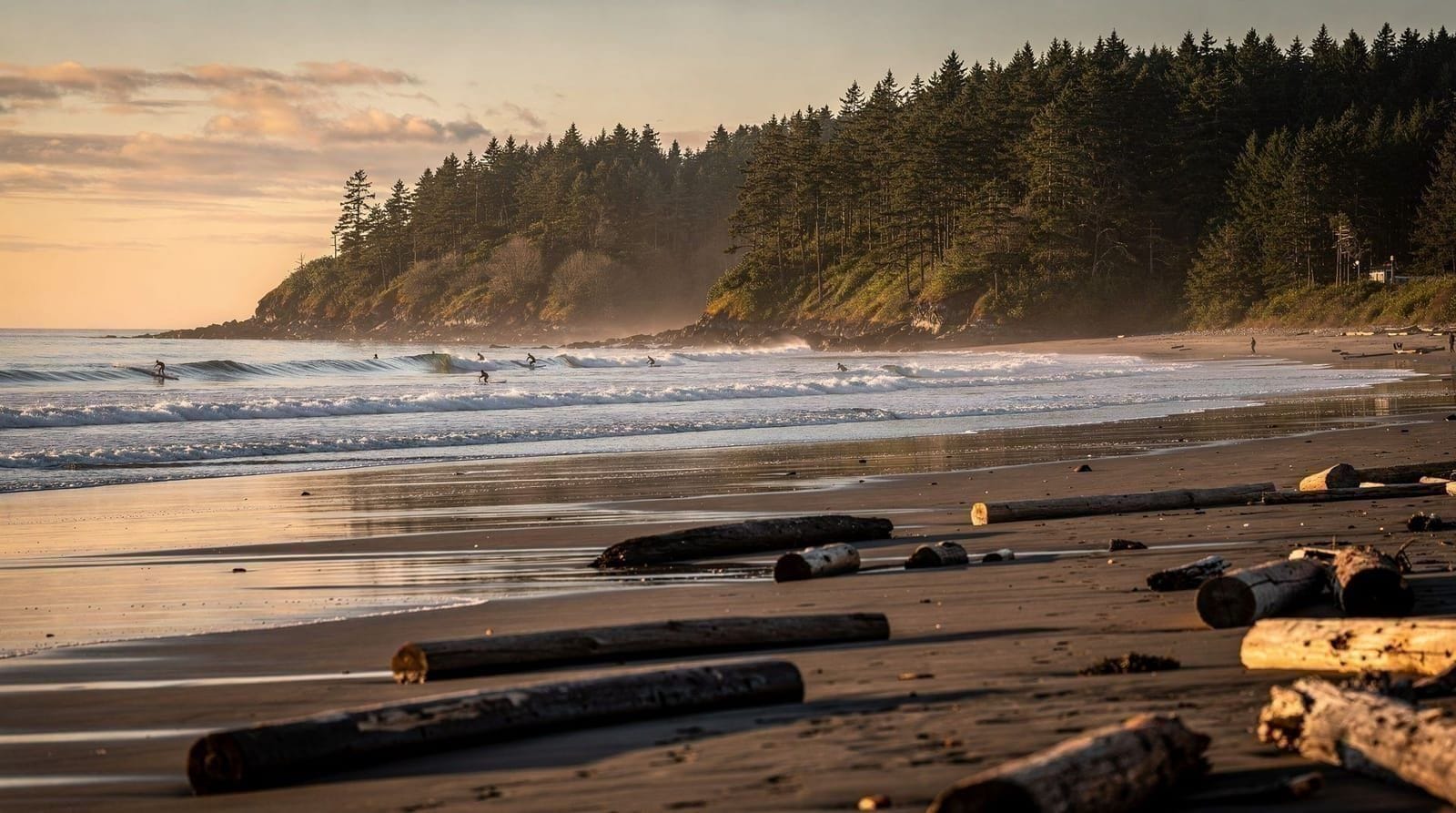
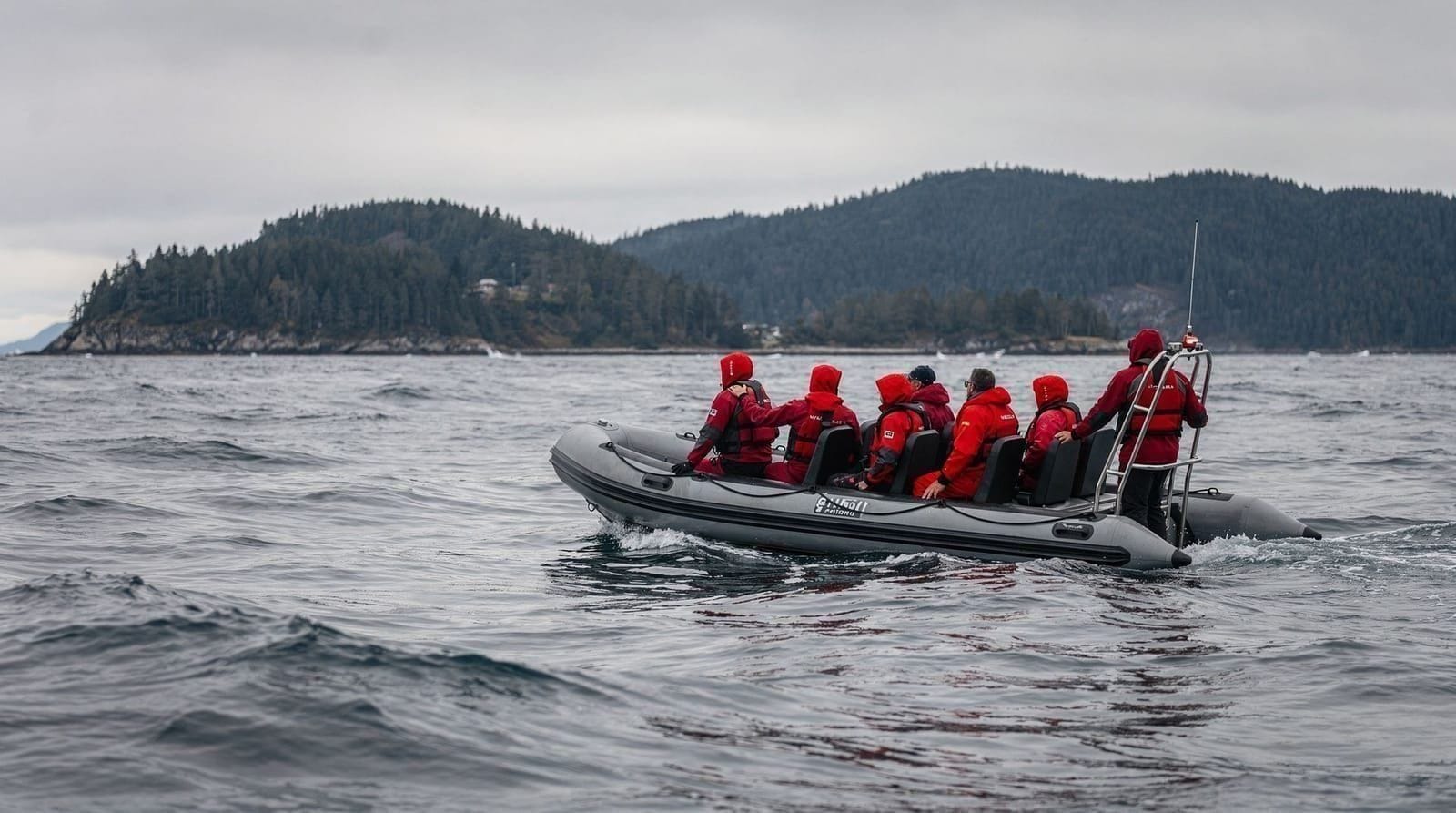
Tofino’s appeal centres on the Pacific coastline and rainforest rather than a single headline attraction. Long Beach, part of Pacific Rim National Park Reserve, is the area’s signature stretch of sand — wide, wild, and popular with surfers year-round, including in winter when storm-watching draws its own dedicated visitor crowd. Whale watching is a major draw between March and October, with gray whales passing during their migration and resident groups visible through summer; a Tofino whale watching tour with a nature guide is one of the most reliably rewarding activities in the area given the volume of marine traffic offshore.
For a different angle on the coast, a Hot Springs Cove tour with a wildlife cruise combines a boat trip through Clayoquot Sound — genuinely excellent for spotting eagles, sea otters, and sometimes bears along the shoreline — with a soak in the area’s namesake natural hot springs, reachable only by boat or floatplane.
Storm watching season
Tofino has built a genuine tourism niche around winter storm watching, drawing visitors specifically for the dramatic Pacific storms that roll in between November and February. It’s a distinctly different experience from the summer beach-and-whale-watching season — moody, atmospheric, and popular with photographers — but it comes with the practical downside of the wettest, most unpredictable driving conditions of the year on Highway 4, making the already-long drive from Vancouver a more demanding undertaking. Travelers specifically chasing storm season should build in extra time buffer for the drive and check road conditions closely before departing.
Clayoquot Sound and further exploring
Beyond the two headline activities of whale watching and Hot Springs Cove, Clayoquot Sound itself offers a wider range of boat-based wildlife experiences worth considering for a longer stay. A Clayoquot Sound wildlife safari boat tour covers a broader stretch of the sound than a standard whale-watching trip, often spotting black bears foraging along the shoreline in addition to marine wildlife, and gives a better sense of the sound’s scale and the scattered Nuu-chah-nulth communities within it.
These tours run longer than a standard whale-watching trip and are best suited to travelers with a full day, or at least most of one, dedicated to the water rather than splitting time between multiple shorter activities.
What it costs
| Item | Approximate cost (CAD) |
|---|---|
| BC Ferries passenger fare, one-way | $16–20 |
| BC Ferries vehicle fare, one-way | $60–75 |
| Flight, one-way per person | $150–300 |
| Overnight accommodation in Tofino | $180–400+ per night, seasonal |
| Whale watching tour, per person | $100–140 |
| Private 2-day guided tour, per person | $500–800+ |
Tofino’s accommodation pricing runs noticeably higher in peak summer than the mainland equivalent, reflecting both its remote location and its status as one of the region’s most sought-after coastal destinations; booking well ahead for July and August visits is worth doing given how limited the town’s overall room inventory is relative to demand.
Travelers comparing this cost against a whale-watching trip run directly from Vancouver should note that the mainland version, while shorter on marine wildlife variety, avoids the accommodation and long-drive costs entirely — a reasonable trade-off for anyone whose main goal is whale watching specifically rather than the broader Pacific coast experience Tofino offers.
Combining Tofino with the rest of Vancouver Island
Given the drive already crosses much of Vancouver Island, some travelers extend the trip to include Victoria or a stop in Nanaimo along the way, effectively turning a Tofino trip into a broader island loop rather than a there-and-back journey. This adds days rather than hours to the itinerary, but makes efficient use of the substantial travel time already invested in reaching the island in the first place, and avoids retracing the exact same route on the return leg.
Weather and what to pack
Tofino’s climate is defined by its exposure to the open Pacific — expect rain in any season, including summer, though it’s far less frequent between June and September than in the wetter fall and winter months. Layered, waterproof clothing is genuinely necessary rather than optional advice here, more so than almost anywhere else covered in this guide, and sturdy footwear matters for both beach walking and any rainforest trail. Surf culture is a visible part of the town’s character, and even non-surfers will notice the wetsuit-clad crowd year-round, a reminder that the water stays cold enough for wetsuits regardless of season.
Choosing your ferry route
Two BC Ferries routes can get a vehicle onto Vancouver Island for a Tofino trip: Tsawwassen to Duke Point (near Nanaimo, about 2 hours), or Horseshoe Bay to Departure Bay (also near Nanaimo, about 1 hour 40 minutes). The Horseshoe Bay route is shorter and often more convenient for travelers starting from the North Shore or willing to drive through the city to reach it, while Tsawwassen suits those coming from the airport or south Vancouver more directly.
Both land you within a similar distance of the Highway 4 turnoff toward Port Alberni and Tofino, so the choice mostly comes down to which terminal is more convenient from your starting point rather than a meaningful difference in total travel time. Vehicle reservations are worth making in advance for either route during summer, particularly on weekends.
Cathedral Grove
About halfway along Highway 4 between Port Alberni and the coast, Cathedral Grove is one of the most accessible old-growth forest stops on Vancouver Island — a short, flat loop trail through stands of Douglas fir and red cedar, some over 800 years old, directly off the highway with no advance planning required. It’s a natural break point on the long drive, taking only 20 to 30 minutes to walk, and gives a tangible sense of the temperate rainforest that defines much of the island’s interior before the highway descends toward the more exposed, wind-shaped coastal forest around Tofino itself.
Tofino and Ucluelet: two towns, one region
Tofino often gets mentioned interchangeably with Ucluelet, its smaller neighbour about 40 minutes south along the same stretch of coast, and the two effectively share the same Pacific Rim National Park Reserve access and much of the same natural draw. Tofino has the larger tourism infrastructure, more dining and accommodation options, and the more developed surf and whale-watching industries; Ucluelet tends to be quieter and somewhat less expensive, with its own strong hiking trail (the Wild Pacific Trail) as a signature draw. Travelers with time for both towns, rather than just one, get a fuller sense of the region, though Tofino remains the more complete single-stop option for a first visit.
Whose territory this is
The Tofino and Clayoquot Sound area sits within the traditional territories of the Tla-o-qui-aht, Ahousaht, and other Nuu-chah-nulth Nations, whose presence in the region long predates the town’s more recent tourism and, before that, resource-industry economy. Clayoquot Sound itself became internationally known in the early 1990s as the site of major old-growth logging protests, a pivotal moment in Canadian environmental history that led to significant protections for the surrounding rainforest — context worth knowing for visitors experiencing the area’s now-protected old-growth stands, since the landscape’s current state reflects a specific, contested history rather than simply having always been preserved.
Surfing in Tofino
Surfing is one of Tofino’s defining activities, unusual for a Canadian destination given the cold Pacific water, and the town has a full complement of surf schools and board rental shops catering to complete beginners as well as experienced surfers drawn by the consistent swell. Long Beach and nearby Cox Bay are the main surf breaks, and lessons typically run a few hours with all gear, including a wetsuit, included given the year-round water temperature. Even travelers with no interest in surfing themselves will find watching the surf culture — wetsuit-clad surfers year-round, board racks outside nearly every accommodation — a genuine part of what makes Tofino feel distinct from the rest of the region.
Family travel considerations
Given the travel time involved, a Tofino trip with young children needs more deliberate planning than most of the region’s other day trips. The drive itself, particularly the winding Highway 4 section, can be difficult for car-sickness-prone kids, and breaking the drive at Cathedral Grove or a coastal pullout helps. Once in Tofino, the area is genuinely family-friendly — Long Beach’s wide, flat sand is easy for kids to explore, and several whale-watching operators run shorter or gentler tour options suited to families. Families without at least one full day free for the trip, given the travel investment required, are generally better served choosing a closer day trip instead.
How Tofino compares to Vancouver’s other big trips
Tofino sits at the far end of the region’s day-trip-to-multi-day spectrum. A Victoria day trip or Butchart Gardens visit both involve a ferry crossing but stay within a single, if long, day; a Whistler day trip is a full but manageable day by road alone.
Tofino is the one major regional destination from Vancouver that genuinely doesn’t fit the day-trip format at all by road, and travelers should mentally file it alongside multi-day trips like the Okanagan rather than alongside the shorter outings on this list. That distinction is worth internalizing early in trip planning, since search results and casual recommendations often lump Tofino in with genuinely feasible day trips without making the travel-time gap clear.
Extending toward a full Vancouver Island trip
Because reaching Tofino already requires the ferry crossing and most of a day’s driving, it pairs naturally with a longer loop covering Victoria and other island stops rather than a there-and-back trip focused solely on the west coast. Travelers with five days or more can realistically combine Victoria, a stop in Nanaimo, and Tofino into a single Vancouver Island circuit, making far more efficient use of the ferry crossing and long driving day than treating Tofino as an isolated add-on to a Vancouver-based trip.
The honest verdict
Tofino rewards the travelers willing to commit real time to reaching it, and it’s a genuinely different kind of coastline than anything closer to Vancouver — wilder, more exposed, and less developed than Victoria or the Gulf Islands. But it is not a day trip in any meaningful sense by road, and visitors trying to force it into a single day should either fly or seriously reconsider whether the destination fits their overall trip. For anyone with two or more days to spare on a Vancouver Island loop, it’s one of the most rewarding extensions available from Vancouver; for anyone strictly limited to a single day, the honest advice is to pick a closer destination instead.
Frequently asked questions about Tofino trip from Vancouver — why it’s not a day trip and how to plan it
Is Tofino worth it if I only have one day?
Only by flying — driving makes a same-day round trip over 11 hours of travel for a few hours in Tofino. If a single day is all that’s available, a closer destination like Victoria or Squamish is the more honest choice.
What’s the best time of year to visit Tofino?
June through September for the driest weather and the best whale-watching odds; November through February draws its own visitors for winter storm-watching, though the drive on Highway 4 gets more demanding in that window.
Top experiences
Bookable activities with verified prices and instant confirmation on GetYourGuide.